MCQ
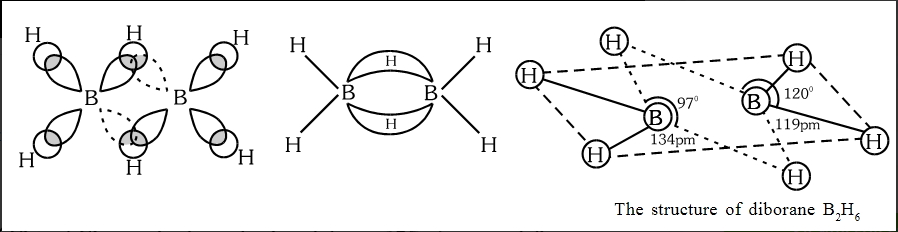
The structure of diborane contains :-
- AFour $2C -2e^-$ bonds & two $2C -3e^-$ bonds
- BTwo $(2C -2e^-)$ bonds & four $3C -2e^-$ bonds
- ✓Four $2C -2e^-$ bonds & two $3C -2e^-$ bonds
- DTwo $2C -2e^-$ bonds & two $3C -2e^-$ bonds
Generate a complete, print-ready paper with questions like this in minutes — across 16+ boards, with answer keys.
If $T _2> T _1$, the correct statement(s) is (are)
(Assume $\Delta H ^{\ominus}$ and $\Delta S ^{\ominus}$ are independent of temperature and ratio of $\ln K$ at $T _1$ to $\ln K$ at $T_2$ is greater than $T_2 / T_1$. Here $H, S, G$ and $K$ are enthalpy, entropy, Gibbs energy and equillibrium constant, respectively.)
$(A)$ $\Delta H ^{\ominus}<0, \Delta S ^{\ominus}<0$ $(B)$ $\Delta G ^{\ominus}<0, \Delta H ^{\ominus}>0$ $(C)$ $\Delta G ^{\ominus}<0, \Delta S ^{\ominus}<0$ $(D)$ $\Delta G ^{\ominus}<0, \Delta S ^{\ominus}>0$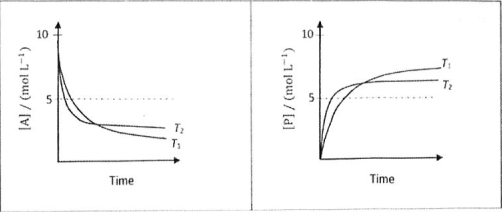
$C{u_{\left( s \right)}} + 2Ag_{\left( {aq} \right)}^ + \to Cu_{\left( {aq} \right)}^{2 + } + 2A{g_{\left( s \right)}}$
$(I)\,\,PCl_3$ hydrolyses in the presence of moisture giving fumes of $HCl$
$(II)\,\,PCl_5$ exists as $[PCl_4]^-[PCl_6]^+$ in solid state
$(III)$ All the five bonds in $PCl_5$ molecule are equivalent
Choose the correct statements
$CH_4\, _{( g )}+4 Cl _{2}\,_{( g )} \rightarrow CCl _{4}\,_{( l )}+4 HCl\,_ {( g )}$