MCQ
The structure of $I F_{7}$ is
  • A
    Square pyramidal
  • B
    Trigonal bipyramidal
  • C
    Octahedral
  • Pentagonal bipyramidal

Answer

Correct option: D.
Pentagonal bipyramidal
d
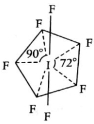
The structure of $I F_{7}$ is pentagonal bipyramidal.

It can be depicted as follow

$(z=53)($ Ground state $)=$

$\mathop {\boxed{ \uparrow  \downarrow }}\limits^{5s} \,\,\mathop {\boxed{ \uparrow  \downarrow }\boxed{ \uparrow  \downarrow }\boxed \uparrow }\limits^{5p} \,\,\mathop {\boxed{}\boxed{}\boxed{}\boxed{}\boxed{}}\limits^{5d} $

$I$ (Excited state) =

$\mathop {\boxed \uparrow }\limits^{5s} \,\,\mathop {\boxed \uparrow \boxed \uparrow \boxed \uparrow }\limits^{5p} \,\,\mathop {\boxed \uparrow \boxed \uparrow \boxed \uparrow \boxed{}\boxed{}}\limits^{5d} $

$I{F_7} = \mathop {\boxed{ \uparrow  \times }}\limits^{5s} \,\,\mathop {\boxed{ \uparrow  \times }\boxed{ \uparrow  \times }\boxed{ \uparrow  \times }}\limits^{5p} \,\,\mathop {\boxed{ \uparrow  \times }\boxed{ \uparrow  \times }\boxed{ \uparrow  \times }\boxed{}\boxed{}}\limits^{5d} $

                    $s p^{3} d^{3}$ -hybridisation

Here, $X$ denotes electrons of $F$ -atoms. The structure of $I F_{7}$ is shown below:

(fig.)

Pentagonal bipyramidal structure
Need a full question paper?

Generate a complete, print-ready paper with questions like this in minutes — across 16+ boards, with answer keys.

Start Generating Free

Similar questions

Given below are some statements concerning formic acid, which of them is true
The required charge for one equivalent weight of silver deposite on cathode is
An organic compound $C_xX_YO_z$ on complete combustion provides equivolume of products $CO_2(g)$ and $H_2O(g)$ which is individually double the volume of organic compound taken. In the process volume of oxygen consumed is same as volume of $CO_2$ produced and liberated heat during combustion is $500 \ kcal/mole$ at constant pressure and at $500\ K$. Formula of organic compoun  & $\Delta U$ for reaction will be -
Tincture of iodine is
Corrosion of iron is essentially an electrochemical phenomenon where the cell reactions are
In which of the following pairs both the complexes show optical isomerism
Which one of the following elements shows both positive and negative oxidation states?
Calculate $\Delta H \,(kJ/mole)$ for the reaction :-
$2FeO_{(s)} + \frac{1}{2}\, O_{2(g)} \to Fe_2O_{3(g)}$

Given                                                                                                   $\Delta H$

$(i)\, Fe_2O_{3(s)}+3C_{(graphite)} \to 2Fe_{(s)} + 3CO_{(g)}$         $492\, kJ/mol$

$(ii)\, FeO_{(s)}+C_{(graphite)} \to Fe_{(s)} + CO_{(g)}$                     $156\, kJ/mol$

$(iii)\, C_{(graphite)} + O_{2(g)} \to CO_{2(g)}$                                   $-393 \,kJ/mol$

$(iv)\, CO_{(g)} + \frac{1}{2}\, O_{2(g)} \to CO_{2(g)}$                            $-283\, kJ/mol$

Which of following is not correct ?
Calculate maximum possible heat which can be released if a $4\ l$ aqueous solution is to be formed by mixing appropriate yolumes of $2\ M\  NaOH$ and $3\ M\  H_2SO_4$ solution $\Delta {H_{{\text{neutralisation}}\,\,{\text{SA/SB}}}} =  - 14\ kcal/mol$ ......$ kcal$