MCQ
The substances having very short plastic region are
  • A
    Ductile
  • Brittle
  • C
    Malleable
  • D
    All of these

Answer

Correct option: B.
Brittle
b
(b)

Substances with short plastic region are brittle because less amount of permanent deformation could be done in them.

Need a full question paper?

Generate a complete, print-ready paper with questions like this in minutes — across 16+ boards, with answer keys.

Start Generating Free

Similar questions

To get three images of a single object, one should have two plane mirrors at an angle of......$^o$
In an experiment of potentiometer for measuring the internal resistance of primary cell a balancing length $\ell $ is obtained on the potentiometer wire when the cell is open circuit. Now the cell is short circuited by a resistance $R$. If $R$ is to be equal to the internal resistance of the cell the balancing length on the potentiometer wire will be
$\overrightarrow A $ and $\overrightarrow B $ are two vectors given by $\overrightarrow A  = 2\widehat i + 3\widehat j$ and $\overrightarrow B  = \widehat i + \widehat j$. The magnitude of  the component (projection) of $\overrightarrow A$ on $\overrightarrow  B$ is
For $\mathrm{He}^{+}$, a transition takes place from the orbit of radius $105.8 \mathrm{pm}$ to the orbit of radius $26.45 \mathrm{pm}$. The wavelength (in $\mathrm{nm}$ ) of the emitted photon during the transition is. . . . .

[Use:  Bohr radius, $\mathrm{a}=52.9 \mathrm{pm}$   Rydberg constant, $R_H=2.2 \times 10^{-18} \mathrm{~J}$  Planck's constant, $\mathrm{h}=6.6 \times 10^{-34} \mathrm{~J} \mathrm{~s}$  Speed of light, $c=3 \times 10^8 \mathrm{~m} \mathrm{~s}^{-1}$ ]
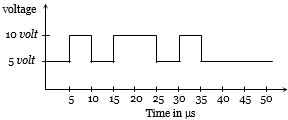
In a negative logic the following wave form corresponds to the
Regarding a semiconductor which one of the following is wrong
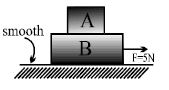
In the shown arrangement mass of $A = 1\,\,kg$  mass of  $B = 2\,\,kg.$  Coefficient of friction between $A $ and $B = 0.2.$  There is no friction between $B$  and ground. The frictional force exerted by $A$ on $B$ equals to
A simple pendulum with iron bob has a time period $T$. The bob is now immersed in a non-viscous liquid and oscillated. If the density of liquid is $\frac{1}{12}$ th that of iron, then new time period will be
In a Fresnel baptism experiment, the two positions of lens give separation between the slits as $16 \;cm$ and $9\; cm$ respectively. What is the actual distance of separation (in $cm$)?
Surface tension of a soap bubble is $2.0 \times 10^{-2}\; Nm ^{-1}$. Work done to increase the radius of soap bubble from $3.5\; cm$ to $7\; cm$ will be $.........\times 10^{-4}\,J$ [Take $\pi=\frac{22}{7}$ ]