Question
The sun emits a light with maximum wavelength 510 mm while another star X emits a light with maximum wavelength of 350 nm. What is the ratio of surface temperature of sun and the star X (a) 2.1(b) 0.68(c) 0.46(d) 1.45
       

Answer

(b) 0.68

Need a full question paper?

Generate a complete, print-ready paper with questions like this in minutes — across 16+ boards, with answer keys.
Start Generating Free

Similar questions

After 1α and 2β emissions(a) Mass number reduces by 3(b) Mass number reduces by 4(c) Mass number reduces by 6(d) Atomic number remains unchanged
   
   
The shortest wavelength in Balmer’s series for Hydrogen atom is ...A... and this is obtained by substituting ...B ... in Balmer’s formula. Here, A and B refer to?
The unit of specific resistance is:
The potential difference in open circuit for a cell is 2.2 volts. When a 4 ohm resistor is connected between its two electrodes the potential difference becomes 2 volts. The internal resistance of the cell will be(a) 1 ohm(b) 0.2 ohm(c) 2.5 ohm(d) 0.4 ohm
       
In order to increase the angular magnification of a simple microscope, one should increase:
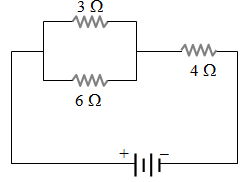
In the figure, current through the $3 \Omega$ resistor is $0.8$ ampere, then potential drop through $4 \Omega$ resistor is
Assertion   :   Anode of Coolidge tube gets heated up at time of emission of X-rays.
Reason      : The anode of Coolidge tube is made of a material of high melting point.(a) If both assertion and reason are true and the reason is the correct explanation of the assertion.(b) If both assertion and reason are true but reason is not the correct explanation of the assertion.(c) If assertion is true but reason is false.(d) If the assertion and reason both are false.


An ionized gas contains both positive and negative ions. If it is subjected simultaneously to an electric field along the +x direction and a magnetic field along the +z direction, then(a) Positive ions deflect towards +y direction and negative ions towards –y direction(b) All ions deflect towards +y direction(c) All ions deflect towards –y direction(d) Positive ions deflect towards –y direction and negative ions towards +y direction


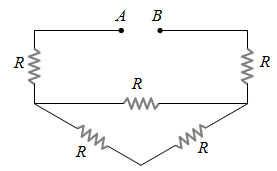
What is the equivalent resistance between $A$ and $B$ in the figure below if $R = 3 \Omega$
The Rutherford $\alpha$-particle experiment shows that most of the $\alpha$-particles pass through almost unscattered while some are scattered through large angles. What information does it give about the structure of the atom