Question
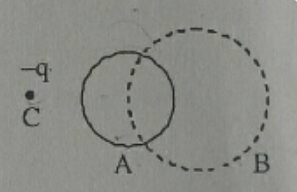
The surface shown in the figure does not represent:
Image

Answer

(b)Static electric field

Need a full question paper?

Generate a complete, print-ready paper with questions like this in minutes — across 16+ boards, with answer keys.

Start Generating Free

Similar questions

If If $\mathrm{n}_{\mathrm{e}}$ and $\mathrm{n}_{\mathrm{h}}$are the number of electrons and holes in a semiconductor heavily doped with phosphorus, then
A charge $Q$ is divided into two parts of $q$ and $Q-q$. If the coulomb repulsion between them when they are separated is to be maximum, the ratio of $\frac{\mathrm{Q}}{\mathrm{q}}$ should be
A radioactive material undergoes decay by ejecting electrons. The electron ejected in this process is:
The instantaneous magnitude of magnetic flux associated with a closed circuit of $5 \Omega$ resistance is given by $\phi_{ B }=6 t^2-5 t+1$, then magnitude of induced current (in A ) in the circuit at $t =0.25$ second is :
Photons of energies $1eV$ and $2eV$ are successively incident on a metallic surface of work function $0.5eV.$ The ratio of kinetic energy of most energetic photoelectrons in the two cases will be:
In the figure shown here, A is a conducting sphere and B is a closed spherical surface. If a-q change is placed at C near A, then the electric flux through the closed surface is -
Which one of the following is more monocromatic?
Two plane mirrors are inclined at an angle of 72° . The number of images of a point object placed between them will be(a) 2(b) 3(c) 4(d) 5
       
Which of the following parameters are the same for all hydrogen-like atoms and ions in their ground states?
  1. Radius of the orbit.
  2. Speed of the electron.
  3. Energy of the atom.
  4. Orbital angular momentum of the electron.
Assertion  :   Annihilation of electron and positron is an example of decay of charges.
Reason      : In the process of annihilation an electron and a positron combine to give a gamma particle.(a) If both assertion and reason are true and the reason is the correct explanation of the assertion.(b) If both assertion and reason are true but reason is not the correct explanation of the assertion.(c) If assertion is true but reason is false.(d) If assertion is false but reason is true.