MCQ
The system$ x + 2y = 3$ and $5x + ky + 7 = 0$ has no solution, when:
  • $\text{k}=10$
  • B
    $\text{k}\neq10$
  • C
    $\text{k}=\frac{-7}{3}$
  • D
    $\text{k}=-21$

Answer

Correct option: A.
$\text{k}=10$
$x + 2y = 3$ and $5x + ky + 7 = 0$
$x + 2y - 3 = 0$ and $5x + ky + 7 = 0$
We know that,
the system of linear equations $a_1x + b_1x + c_1 = 0, a_2x + b_2y + c_2 = 0$
has a unique solution if $\frac{\text{a}_1}{\text{a}_2}=\frac{\text{b}_1}{\text{b}_2}\neq\frac{\text{c}_1}{\text{c}_2}.$
So, $\frac{1}{5}=\frac{2}{\text{k}}\neq\frac{-3}{7}$
$\Rightarrow\frac{1}{5}=\frac{2}{\text{k}}$
$\Rightarrow\text{k}=0.$

Need a full question paper?

Generate a complete, print-ready paper with questions like this in minutes — across 16+ boards, with answer keys.
Start Generating Free

Similar questions

If the radii of the ends of a bucket are $5\ cm$ and $15\ cm$ and it is $24\ cm$ high, then its surface area is:
The ratio in which the line segment joining $P(x_1, y_1)$ and $Q(x_2, y_2)$ is divided by $x-$axis is:
If $\text{x}=\text{a}\sec\theta \text{ and y}=\text{b}\tan\theta,$ then $b^2x^2 - a^2y^2 $=
Select the appropriate alternative.
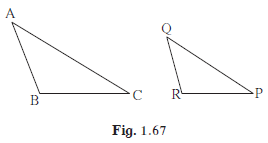
In Δ ABC and ΔPQR, in a one to one correspondence $\frac{A B}{Q R}=\frac{B C}{P R}=\frac{C A}{P Q}$ then

A. Δ PQR ~ Δ ABC
B. Δ PQR ~ Δ CAB
C. Δ CBA ~ Δ PQR
D. Δ BCA ~ Δ PQR
A hollow metallic sphere with external diameter $8\ cm$ and internal diameter $4\ cm$ is melted and moulded into a cone of base radius $8\ cm.$ The height of the cone is:
Each question consists of two statements, namely, Assertion $(A)$ and Reason $(R)$. for selecting the correct answer, use the following code:
Assertion $(A)$
Reason $(R)$
 
At a point $P$ of a circle with centre $O$ and radius $12cm$, a tangent $PQ$ of length $16\ cm$ is drawn. Then, the point of contact. $OQ = 20\ cm.$
The tangent at any point of a circle is perpendicular to the radius through the point of contact.
If the system of equations has infinitely many solutions, then:
$2x + 3y = 7$
$(a + b)x + (2a - b)y = 21$
If $2x - 3y = 7$ and $(a + b)x - (a + b - 3)y = 4a + b$ have an infinite number of solutions, then:
A die is thrown once. The probability of getting an odd number greater than $3$ is:
$\ce{LCM}$ of $(2^3 \times 3 \times 5)$ and $(2^4 \times 5 \times 7)$ is: