MCQ
The temperature of a solid object is observed to be constant during a period. In this period:
  • A
    Heat may have been supplied to the body.
  • B
    Heat may have been extracted from the body.
  • Both $A$ and $B$
  • D
    No heat ia ertracted from the body.

Answer

Correct option: C.
Both $A$ and $B$
If there is no temperature change in a solid object, there is a possibility that the heat might have been supplied to the body that was used up in breaking the bond of the molecules, changing the state of the solid. This is why the temperature of the solid remians constant. Similar is the case when the heat is extracted from the body to change its state.
Since there is a possibility of supplying or extracting heat from the solid, we cannot say that heat is not supplied to the solid or is not extracted from the solid.

Need a full question paper?

Generate a complete, print-ready paper with questions like this in minutes — across 16+ boards, with answer keys.
Start Generating Free

Similar questions

Two discs of same thickness but of different radii are made of two different materials such that their masses are same. The densities of the materials are in the ratio $1 : 3$.  The moments of inertia of these discs about the respective axes passing through their centres and perpendicular to their planes will be in the ratio 
A body moves from rest with a constant acceleration. Which one of the following graphs represents the variation of its kinetic energy $K$ with the distance travelled $x $ ?
A particle moves in east direction with $15 \,m/sec$. for $2\, sec$ then moves northward with $5\, m/sec$. for  $8 \,sec$. then average velocity of the particle is  
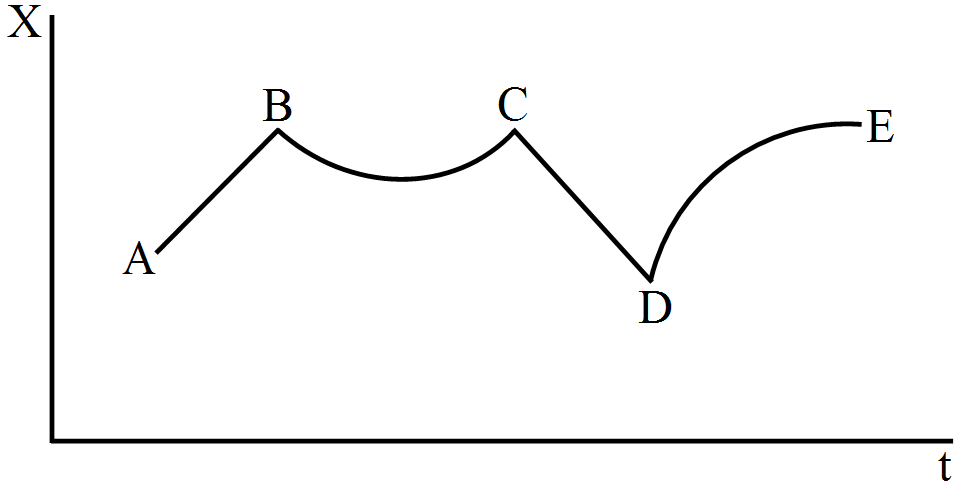
Figure shows the displacement of a particle going along the $X-$axis as a function of time. The force acting on the particle is zero in the region:
  1. $AB$
  2. $BC$
  3. $CD$
  4. $DE$
A mass $M$, attached to a horizontal spring, executes S.H.M. with amplitude $A_1$. When the mass $M$ passes through its mean position then a smaller mass $m$ is placed over it and both of them move together with amplitude $A_2$. The ratio of $\frac{{{A_1}}}{{{A_2}}}$ is
The particle displacement of a travelling longitudional wave is represented by $\xi  = \xi (x,t)$. The midpoints of a compression zone and an adjacent rarefaction zone are represented by the letter ‘$C’$ and $‘R’$. Which of the following is true?
Faraday is the unit of
A man (mass $= 50\, kg$) and his son (mass $= 20\, kg$) are standing on a frictionless surface facing each other. The man pushes his son so that he starts moving at a speed of $0.70\, ms^{-1}$ with respect to the man. The speed of the man with respect to the surface is ........ $ms^{-1}$
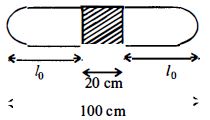
A thin tube sealed at both ends is $100\, cm$ long. It lies horizontally, the middle $20\, cm$ containing mercury and two equal ends containing air at standard atmospheric pressure . If the tube is now turned to a vertical position, by what amount will the mercury be displaced ? (Given : cross-section of the tube can be assumed to be uniform) ........ $cm$
Figure shows three blocks in contact and kept on a smooth horizontal surface. What is ratio of force exerted by block $A$ on $B$ to that of $B$ on $C$