MCQ
The term ’active immunity' means
  • Resistance developed after disease
  • B
    Resistance developed before disease
  • C
    Resistance rate of heart beat
  • D
    Increasing quantity of blood

Answer

Correct option: A.
Resistance developed after disease
a
It’s obvious.
 

Need a full question paper?

Generate a complete, print-ready paper with questions like this in minutes — across 16+ boards, with answer keys.

Start Generating Free

Similar questions

Haemodialysis helps in the patient having
Choose correct sequence of mechanism of vision
(i) The light rays in visible wavelength focused on the retina through the cornea and lens
(ii) Light induces dissociation of the retinal from opsin resulting in changes in the structure of the opsin
(iii) This causes membrane permeability changes.
(iv) Potential differences are generated in the photoreceptor cells rods and cones
(v) This produces a signal that generates action potentials in the ganglion cells through the bipolar cells.
(vi) These action potentials (impulses) are transmitted by the optic nerves to the visual cortex area of the brain.
(vii) Where the neural impulses are analysed and the image formed on the retina is recognised based on earlier memory and experience.
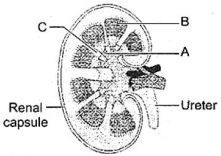
In given diagram of kidney A, B and C represents:
Image
6000 to 8000 ml of air is the:
In which one of the following organisms its excretory organs are correctly stated?
Mark the given statements True (T) or False (F).
(i) Squamous epithelium is found in wall of blood vessels and air sacs of lungs.
(ii) Cuboidal epithelium is found in ducts of glands and Henle's loop of nephrons.
(iii) Columnar epithelium lines the inner surface of stomach and intestine.
(iv) The columnar or cuboidal cells bearing cilia on their surface are called ciliated epithelium and are present in inner surface of solid organs like bronchioles and fallopian tubes.
(V) The goblet cells of alimentary canal has unicellular type of glandular epithelium whereas salivary gland has multicellular type.
(vi) Compound epithelium covers the dry surface of the skin, moist surface of buccal cavity, pharynx, innerlining of duct of salivary gland and of pancreatic duct.
(vii) Tight junctions help to stop substances from leaking across a tissue whereas gap junction facilitate cells to communicate with each other by connecting the cytoplasms of adjoining cells.
(viii) Adhering junctions performs cementing to keep neighbouring cells together.
(ix) In all connective tissue the cells secrete fibres of structural proteins called collagen or elastin.
(x) Tendon attach skeletal muscles to bones and ligament attach one bone to another and both are example of loose regular type of connective tissue,
(xi) The cells of cartilage called chondrocytes are enclosed in large cavities within matrix secreted by them.
(xii) The cells of bone called osteocytes are present in the spaces called lacunae.
(xiii) The bone-marrow in all bone is the site of production of blood cells.
(xiv) The fibres of muscle tissue are composed of numerous fine fibrils, called myofibrils,
(xv) The smooth muscle fibres taper at both ends (fusiform) and show striation.
Choose the correct option given below :-
Match List $I$ with List $II$

List $I$ List $II$
$A.$  Common cold $I.$  Plasmodium
$B.$  Haemozoin $II.$  Typhoid
$C.$  Widal test $III.$  Rhinoviruses
$D.$  Allergy $IV.$  Dust mites

:Choose the correct answer from the options given below :

Which one of the following statements are incorrect ?
(A) Cnidarians exhibit two basic body forms called medusa (sessile and cylindrical form) and polyp (free-swimming and umbrella shaped).
(B) The phenomenon exhibited by some Cinidarians in which both forms exhibit alternation of generation is termed as metastasis.
(C) Polyps produce medusae by sexually and meduase forms polyp by asexually reproduction.
(D) Physalia is known as Portuguese man-of-war; Adamsia as Sea anemone; Pennatula as Sea pen; Gorgonia as Sea fan and Meandrina as Brain coral.
(E) Ctenophores are commonly known as seawalnuts or comb jellies.
(F) Ctenophores are exclusively marine and body bears eight external rows of ciliated comb plates that help in locomotion.
(G) Bioluminescence is the property of living organism to emit light and is well marked by ctenophores.
(H) Reproduction in ctenophore takes place by sexual means. Fertilisation is external with indirect development.
(I) Hooks and Sucker are present in parasitic form of members of Aschelminthes.
(J) Specialized cells called flame cells help in osmoregulation and excretion in platyhelminthes.
(K) In platyhelminthes, fertilization is internal with direct development.
(L) Some members of platyhelminthes like planaria possess high regeneration capacity.
(M) Taenia, a member of phylum platyhelminthes is commonly called tapeworm and fasciola is commonly called as liver fluke.
(N) The alimentary canal in members of aschelminthes is complete with a well- developed muscular pharynx.
(0) The males are longer than females in members of aschelminthes.
(P) The members of aschelminthes are dioecious as sexes are separate. Fertilisation is internal and development is indirect.
(Q) Ascaris, a member of phylum aschelminthes are commonly known as round worms; Wuchereria as filarial worm and Ancyclostoma as hookworms.
Choose the correct option given below :-
The hormone released from placenta is
Which of the following act is responsible for the depolarisation of the neuron?