Question
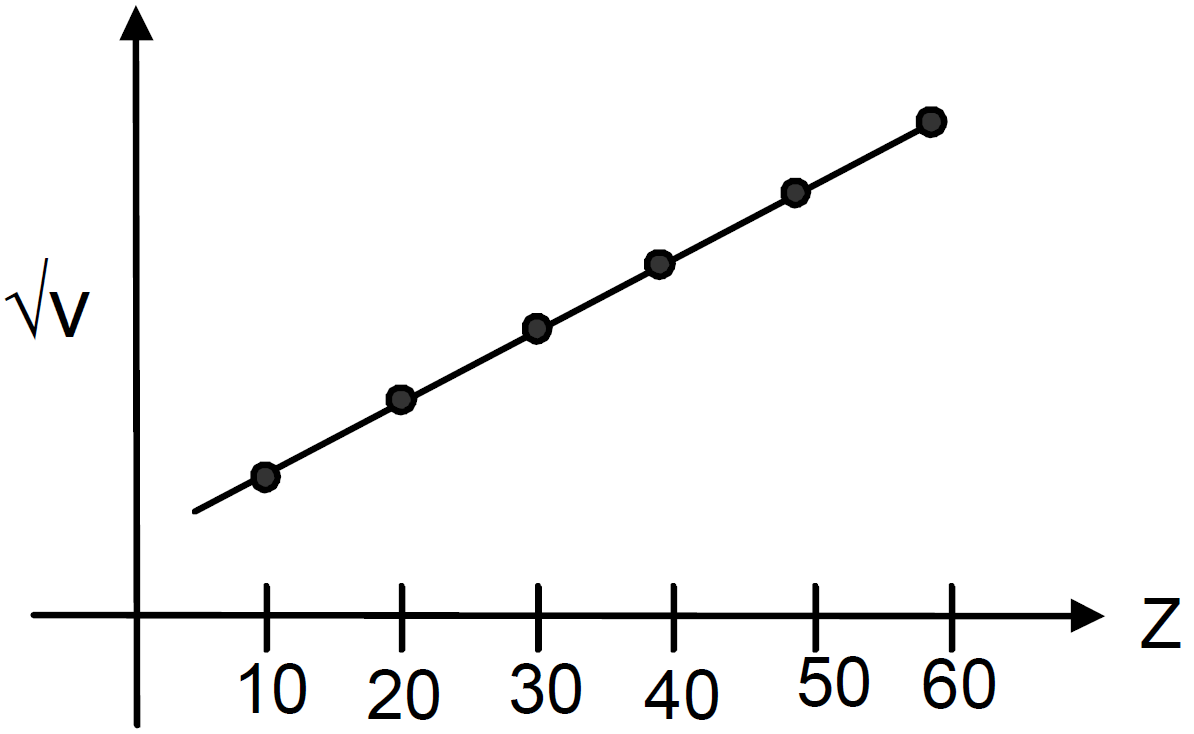
The $\text{K}_\beta$ X-rays from certain elements are given below. Draw a Moseley-type plot of $\sqrt{\text{v}}$ versus Z for $\text{K}_\beta$ radiation.
Element
Ne
P
Ca
Mn
Zn
Br
Energy (keV)
0.858
2.14
4.02
6.51
9.57
13.3

Answer


$\text{K}_\text{B}$ radiation is when the e jumps from
n = 3 to n = 1 (here n is principal quantum no)
$\Delta\text{E}=\text{hv}=\text{Rhc(z-h)}^2\Big(\frac{1}{2^2}-\frac{1}{3^2}\Big)$
$\sqrt{\text{v}}=\sqrt{\frac{9\text{RC}}{8}}(\text{z}-\text{h})$
$\therefore\sqrt{\text{v}}\propto\text{z}$
Second method :
We can directly get value of v b
hv = Energy
$\Rightarrow\text{v}=\frac{\text{Energy(in Kev)}}{\text{h}}$
This we have to find out $\sqrt{\text{v}}$ and draw the same graph as above.

Need a full question paper?

Generate a complete, print-ready paper with questions like this in minutes — across 16+ boards, with answer keys.

Start Generating Free

Similar questions

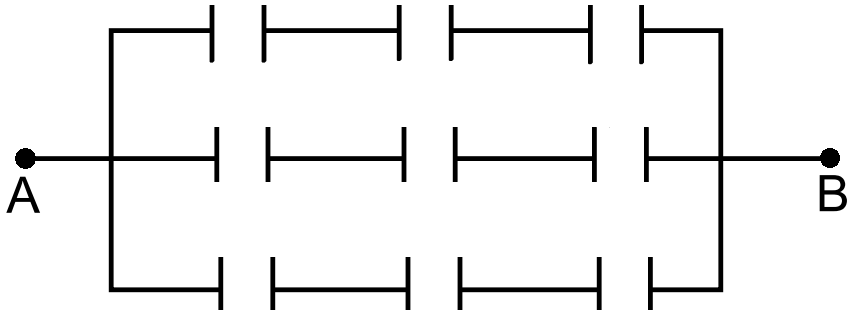
Each of the capacitors shown in figure has a capacitance of $2\mu\text{F}.$ Find the equivalent capacitance of the assembly between the points A and B. Suppose, a battery of emf 60 volts is connected between A and B. Find the potential difference appearing on the individual capacitors.
An optical instrument used for angular magnification has a 25D objective and a 20D eyepiece. The tube length is 25cm when the eye is least strained.
  1. Whether it is a microscope or a telescope?
  2. What is the angular magnification produced?
What is the difference between cathode rays and beta rays? When the two are travelling in space, can you make out which is the cathode ray and which is the beta ray?
(a) Obtain an expression for current flowing through an ideal inductor joined with an ac source of voltage $v=v_0 \sin \omega t$ by using phasor diagram. Draw a graph between (i) voltage applied and (ii) current as a function of (wt.).
(b) Obtain an expression for average power dissipation in any series LCR circuit.
In fig., the circuit symbol of a logic gate and two input waveforms A and B are shown:
  1. Name the logic gate.
  2. Write its truth table.
  3. Give the output waveform.
An aluminium vessel of mass 0.5kg contains 0.2kg of water at $20^\circ C.$ A block of iron of mass 0.2kg at $100^\circ C$ is gently put into the water. Find the equilibrium temperature of the mixture. Specific heat capacities of aluminium, iron and water are $910Jkg^{-1}-K^{-1}$, $470Jkg^{-1}-K^{-1}$ and $4200Jkg^{-1}-K^{-1}$ respectively.
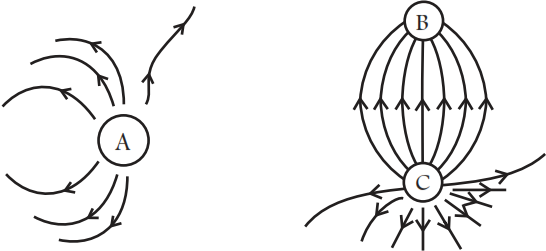
Fig. shows the electric field lines around three point charges A, B and C.
  1. Which charges are positive?
  2. Which charge has the largest magnitude? Why?
  3. In which region or regions of the picture could the electric field be zero? Justify your answer.
  1. Near A,
  2. Near B,
  3. Near C,
  4. Nowhere.
An object 1.5 cm in size is placed on the side of the convex lens in the arrangement (a) above. The distance between the object and the convex lens is 40 cm. Determine the magnification produced by the two-lens system, and the size of the image.
What is meant by electric field lines? Give examples of electric field lines due to different charge distributions and also write their characteristics.
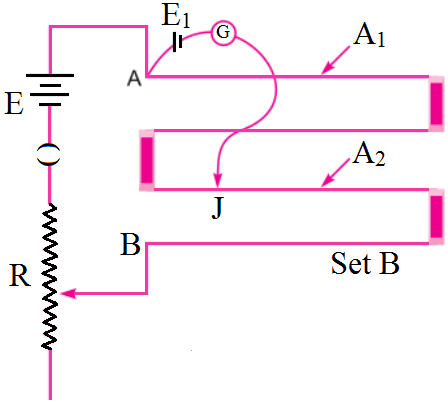
You are given two sets of potentiometer circuits to measure the emf $E_1 $ of a cell. Set A: consists of a potentiometer wire of a material of resistivity $\rho_1$, area of cross-section $A_1$ and length l. Set B: consists of a potentiometer of two composite wire of equal lengths $\frac{\text{l}}2{}$ each, of resistivity $\rho_1,\rho_2$ and area of cross-section $A _1,A_2$ respectively.

Find the relation between resistivity of the two wires with respect to their area of cross section, if the current flowing in the two sets is same. Compare the balancing length obtained in the two sets.