MCQ
The thickness of cathode increases in:
  • Electrorefining of copper.
  • B
    Electroplating of copper.
  • C
    Anodizing of copper.
  • D
    None of the above.

Answer

Correct option: A.
Electrorefining of copper.
In electrolysis of copper, pure copper gets deposited on cathode while impure copper goes to anode. So, the cathode increases in thickness.

Need a full question paper?

Generate a complete, print-ready paper with questions like this in minutes — across 16+ boards, with answer keys.
Start Generating Free

Similar questions

Which silver halide is used in medicine
A $1.84\,mg$ sample of polyhydric alcoholic compound ' $X$ ' of molar mass $92.0\,g / mol$ gave $1.344\,mL$ of $H _{2}$ gas at $STP$. The number of alcoholic hydrogens present in compound ' $X$ ' is $.....$
Antiseptics are a class of $.......$ drugs.
A solution containing $12.5\, g $ of non-electrolyte substance in $250\, g$ of water shows  boiling point elevation of $0.52\, K.$ Calculate the molar mass of the substance. $(K_b = 0.52\, K \, kg \,mol^{-1})$ ......... $g \,mol^{-1}$.
Which of the following oxoacids of phosphorus has strongest reducing property?
Which of them is not equal to zero for an ideal solution ?
The unit of rate constant for a zero order reaction is
The ratio of $\frac{{{C_p}}}{{{C_v}}}$ for inert gases is
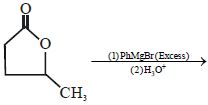
The major product formed in the reaction is
Arrange the compounds in order of decreasing reactivity for nucleophilic additon reaction

$\mathop {\begin{array}{*{20}{c}}
  {O\,\,\,\,\,\,\,\,\,\,\,\,\,} \\ 
  {||\,\,\,\,\,\,\,\,\,\,\,\,} \\ 
  {C{H_3} - C - C{H_2} - Cl} 
\end{array}}\limits_{\left( I \right)} $    $\underset{(II)}{\mathop{\begin{matrix}
   \,\,\,\,\,\,\,\,\,\,\,\,\,\,\,\,\,\,O  \\
   \,\,\,\,\,\,\,\,\,\,\,\,\,\,\,\,\,\,\,\,\,||\,\,\,  \\
   Cl-C{{H}_{2}}-C-H  \\
\end{matrix}}}\,$

$\mathop {\begin{array}{*{20}{c}}
  O \\ 
  {||} \\ 
  {H - C - H} 
\end{array}}\limits_{\left( {III} \right)} $    $\mathop {\begin{array}{*{20}{c}}
  O \\ 
  {||} \\ 
  {{H_3}C - C - C{H_3}} 
\end{array}}\limits_{\left( {IV} \right)} $