MCQ
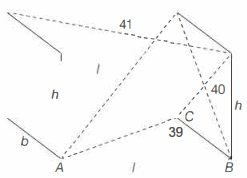
The three different face diagonals of a cuboid (rectangular parallelopiped) have lengths $39,40,41$. The length of the main diagonal of the cuboid which joins a pair of opposite corners is
  • $49$
  • B
    $49 \sqrt{2}$
  • C
    $60$
  • D
    $60 \sqrt{2}$

Answer

Correct option: A.
$49$
a
(a)

Let the length, breadth and height of cuboid is $l, b$ and $h$ respectively.

$Given, l^2+h^2=39^2$

$\Rightarrow b^2+h^2=40^2$

$\Rightarrow \quad l^2+b^2=41^2$

$\Rightarrow \quad 2\left(l^2+b^2+h^2\right)=39^2+40^2+41^2$

$\Rightarrow \quad l^2+b^2+h^2=2401$

$\therefore$ Length of longest diagonal

$=\sqrt{l^2+b^2+h^2}$

$=\sqrt{2401}=49$
Need a full question paper?

Generate a complete, print-ready paper with questions like this in minutes — across 16+ boards, with answer keys.

Start Generating Free

Similar questions

A variable circle is drawn passing through the origin $'O'.$ It intersects $X\, \& \,Y$ axis respectively at points $A\, \& \,B$ such that $OA + 2OB = K$ (non zero constant), then circle always passes through a fixed point $P$ other than origin. $P$ lies on -
Given the inverse trigonometric function assumes principal values only. Let $x, y$ be any two real numbers in $[–1,1]$ such that $\cos ^{-1} x -\sin ^{-1} y =\alpha, \frac{-\pi}{2} \leq \alpha \leq \pi$.Then, the minimum value of $x^2+y^2+2 x y \sin \alpha$ is
If $A  \cap B = B$, then
A test consists of $6$ multiple choice questions, each having $4$ alternative ans wers of which only one is correct. The number of ways, in which a candidate answers all six questions such that exactly four of the answers are correct, is
Inverse of the function $y = 2x - 3$ is
 $(i)$  $f (x)$ is continuous and defined for all real numbers

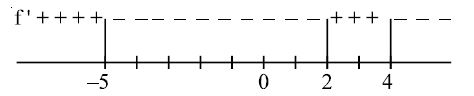
$(ii)$ $f '(-5) = 0 \,; \,f '(2)$ is not defined and $f '(4)  = 0$

$(iii)$ $(-5, 12)$ is a point which lies on the graph of $f (x)$

$(iv)$ $f ''(2)$ is undefined, but $f ''(x)$ is negative everywhere else.

$(v)$ the signs of  $f '(x)$ is given below

On the possible graph of $y = f (x)$ we have  
Let $y = {x^2}{e^{ - x}}$, then the interval in which $y $ increases with respect to $x$  is
$\tan 75^\circ - \cot 75^\circ = $
$\int_{}^{} {\frac{{dx}}{{\sqrt {1 + x} + \sqrt x }} = } $
The number of real solutions of ${\tan ^{ - 1}}\sqrt {x(x + 1)} + {\sin ^{ - 1}}\sqrt {{x^2} + x + 1} = \frac{\pi }{2}$ is