MCQ
The three elements $X, Y$ and $Z$ with electronic configurations shown below all form hydrides

Element Electronic configuration
$X$ $1s^2\,2s^2\,2p^2$
$Y$ $1s^2\,2s^2\,2p^6\,3s^1$
$Z$ $1s^2\,2s^2\,2p^6\,3s^2\,3p^6\,3d^{10}\,4s^2\,4p^5$

Which set of properties match correctly with properties of the hydrides of these elements

  •   hydried of $X$ hydried of $Y$  hydried of $Z$ 
    $(a)$

    hydride of $X$ colourless gas insoluble in $H_2O$

    Silver/grey solid reacts with $H_2O$ to from an alkali  colourless gas forms a strong acid in $H_2O$
  • B
      Hydride of $X$ Hydride of $Y$ Hydride of $Z$
    $(b)$ Colourless liquid, no reaction with $H_2O$ Silver/grey solid forms $H_2$ and $H_2O$ Ionic solid with formula $ZH$
  • C
      Hydride of $X$ Hydride of $Y$ Hydride of $Z$
    $(c)$ Non-polar compound reacts with $Cl_2$ in light Silver/grey ionic solid with formula $YH_2$ Forms when water is added to phosphorus and elemental $Z$.
  • D
      Hydride of $X$ Hydride of $Y$ Hydride of $Z$
    $(d)$ Colourless gas which burns which air Silver/grey solid which reacts violently with acids Colourless, corrosive liquid at $STP$
Answer

Correct option: A.
  hydried of $X$ hydried of $Y$  hydried of $Z$ 
$(a)$

hydride of $X$ colourless gas insoluble in $H_2O$

Silver/grey solid reacts with $H_2O$ to from an alkali  colourless gas forms a strong acid in $H_2O$
a
$2NaOH + Cl_2 \to NaCl + NaOCl + H_2O$

hence $Cl^-$ and $OCl^-$

Need a full question paper?

Generate a complete, print-ready paper with questions like this in minutes — across 16+ boards, with answer keys.

Start Generating Free

Similar questions

$S{n^{ +2 }}$ loses two electrons in a reaction. What will be the oxidation number of tin after the reaction
A $250.0\,mL$ sample of a $0.20\,M\,Cr^{3+}$ is electrolyzed with a current of $96.5\,A$ . If the remaining $[Cr^{3+}]$ is $0.1\,M$ the duration of process is .............. $\mathrm{s}$ (Atomic weight of $Cr = 52$ )
The main product of reaction alcoholic silver nitrite and ethyl bromide. is
Aromatic properties of benzene are proved by
Methanides are
Which of the following pair is not isoelectronic species? (At. no. $Sm , 62 ; Er , 68: Yb , 70: Lu , 71 ; Eu , 63: Tb$, $65$; $\operatorname{Tm}, 69)$
The correct match between Item $I$ and Item $II$ is
Item $I$  Item $II$
$A$ Allosteric effect $P$ Molecule binding to the active site of enzyme
$B$ Competitive inhibitor $Q$ Molecule crucial for communication in the body
$C$ Receptor $R$ Molecule binding to a site other than the active site of enzyme
$D$ Poison $S$ Molecule binding to the enzyme covalently
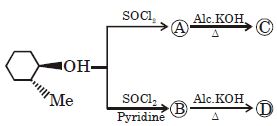
Major product $(C)$  and  $(D)$ will be respectively
Given below are two statements :
Statement (I) : Molal depression constant $K _{ f }$ is given by $\frac{ M _1 R T_f}{\Delta S_{\text {fus }}}$, where symbols have their usual meaning.
Statement (II) : $K _{ f }$ for benzene is less than the $K _{ f }$ for water.
In the light of the above statements, choose the most appropriate answer from the options given below :
$5\, g$ of $Na_2SO_4$ was dissolved in $x\,g$ of $H_2O$. The change in freezing point was found to be $3.82\,^oC$. lf $Na_2SO_4$ is $81.5\%$ ionised, the value of $x$ ($K_f$ for water $= 1.86\,^oC\, kg\, mol^{-1}$) is approximately .............. $\mathrm{g}$ (molar mass of $S = 32\, g\, mol^{-1}$ and that of $Na = 23\, g\, mol^{-1}$)