MCQ
The tones that are separated by three octaves have a frequency ratio of
  • A
    $3$
  • B
    $6$
  • $8$
  • D
    $16$

Answer

Correct option: C.
$8$
c
(c)

Each octaves is double the frequency of the previous octave.

If initial frequency is $f$.

Final frequency $=2 \times 2 \times 2 f$ or $2^3 f$ or $8 f$

$\therefore$ Frequency ratio $=8: 1$.

Need a full question paper?

Generate a complete, print-ready paper with questions like this in minutes — across 16+ boards, with answer keys.
Start Generating Free

Similar questions

An ideal black body at room temperature is thrown into a furnace. It is observed that
A pendulum bob of mass $50 \,gm$ is suspended from the ceiling of an elevator. The tension in the string if the elevator goes up with uniform velocity is approximately .......... $N$
A body cools from ${60^o}C$ to ${50^o}C$ in $10$ minutes when kept in air at ${30^o}C$. In the next $10$ minutes its temperature will be
A particle travels half of the distance of a straight journey with a speed $6 \,m / s$. The remaining part of the distance is covered with speed $2 \,m / s$ for half of the time of remaining journey and with speed $4 \,m / s$ for the other half of time. The average speed of the particle is ....... $m / s$
Unit vector does not have any .......
The area of cross-section of a wire of length $1.1$ metre is $1$ $mm^2$. It is loaded with $1 \,kg.$ If Young's modulus of copper is $1.1 \times {10^{11}}\,N/{m^2}$, then the increase in length will be ......... $mm$ (If $g = 10\,m/{s^2})$
What is the change in temperature on Fahrenheit scale and Kelvin scale, if an iron piece is heated from $30\ ^oC$ to $90\ ^oC$?
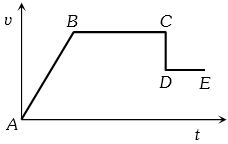
The adjoining diagram shows the velocity versus time plot for a particle. The work done by the force on the particle is positive from
The time period of a particle executing $S.H.M.$ is $8 \,s$. At $t=0$ it is at the mean position. The ratio of distance covered by the particle in $1^{\text {st }}$ second to the $2^{\text {nd }}$ second is .............. $s$
Add vectors $\overrightarrow{ A }, \overrightarrow{ B }$ and $\overrightarrow{ C }$ each having magnitude of $50$ unit and inclined to the $X$-axis at angles $45^{\circ}, 135^{\circ}$ and $315^{\circ}$ respectively.