Question
The torque of a force $\overrightarrow{\text{F}}$ about a point is defined as $\overrightarrow{\text{r}}=\overrightarrow{\text{r}}\times\overrightarrow{\text{F}}.$ Suppose $\overrightarrow{\text{r}}, \overrightarrow{\text{F}}$and $\overrightarrow{\text{r}}$ are all nonzero. Is $\text{r}\times\overrightarrow{\text{r}}\Bigg|\Bigg|\overrightarrow{\text{F}}$ always true? Is it ever true?
Answer

No, $\overrightarrow{\text{r}}\times\overrightarrow{\text{r}}\Bigg|\Bigg|\overrightarrow{\text{r}}$ is not true. In fact, it is never true. This is because:$\overrightarrow{\text{r}}\times\overrightarrow{\text{r}}$
$=\overrightarrow{\text{r}}\times\Big(\overrightarrow{\text{r}}\times\overrightarrow{\text{F}}\Big)$
Applying vector triple product, we get:$\overrightarrow{\text{r}}\times\Big(\overrightarrow{\text{r}}\times\overrightarrow{\text{F}}\Big)$
$=\Big(\overrightarrow{\text{r}}.\overrightarrow{\text{F}}\Big)\overrightarrow{\text{r}}-\Big(\overrightarrow{\text{r}}.\overrightarrow{\text{r}}\Big)\overrightarrow{\text{F}}$
$\because\overrightarrow{\text{r}}.\overrightarrow{\text{r}}=\text{r}^2$
$=\Big(\overrightarrow{\text{r}}.\overrightarrow{\text{F}}\Big)\overrightarrow{\text{r}}-\text{r}^2\overrightarrow{\text{F}}$
If $\overrightarrow{\text{r}}.\overrightarrow{\text{F}}=0;$ that is, $\overrightarrow{\text{r}}\perp\overrightarrow{\text{F}},$ then:$\overrightarrow{\text{r}}\times\overrightarrow{\text{r}}=-\text{r}^2.\overrightarrow{\text{F}}$
We know that $r^2$ is never negative and $\overrightarrow{\text{r}}\times\overrightarrow{\text{r}}=-\text{r}^2.\overrightarrow{\text{F}}$ This implies that both vectors may be antiparallel to each other but not parallel.

Need a full question paper?

Generate a complete, print-ready paper with questions like this in minutes — across 16+ boards, with answer keys.

Start Generating Free

Similar questions

A person wears glasses of power -2.5D. Is the person farsighted or nearsighted? What is the far point of the person without the glasses?
Define conservative and non- conservative forces. Give examples of these also
For the harmonic travelling wave $\text{y}=2\cos2\pi(10\text{t}-0.0080\text{x}+3.5)$ where x and y are in cm and t is second. What is the phase difference between the oscillatory motion at two points separated by a distance of:
4m
The diameters of two planets are in the ratio $4: 1$ and the ratio of their density is $1: 2$. What will be the ratio of gravitational accelerations on the planets?
Find the scalar and vector products of two vectors. $a =(3 \hat{ i }-4 \hat{ j }+5 \hat{ k })$ and $b =(-2 \hat{ i }+\hat{ j }+3 \hat{ k })$
A body is accelerating with 'a' $m/ s^2$ while its mass is increasing at the rate of 'm'. What will be the force experienced by it?
Two cylinders $A$ and $B$ of equal capacity are connected to each other via a stop$-$cock. $'A\ '$ contains a gas at $\text{S.T.P.} 'B\ '$ is completely evacuated. The entire system is thermally insulated. The stop$-$cock is suddenly opened.Answer the following:
  1. What is the change in internal energy of the gas?
  2. What is the change in the temperature of the gas?
The orbital velocity $\nu$ of a satellite may depend on its mass $m$, distance $r$ from the centre of earth and acceleration due to gravity g. Obtain an expression for orbital velocity.
Two cylinders A and B of equal capacity are connected to each other via a stopcock. A contains a gas at standard temperature and pressure. B is completely evacuated. The entire system is thermally insulated. The stopcock is suddenly opened. Answer the following: Do the intermediate states of the system (before settling to the final equilibrium state) lie on its P-V-T surface?
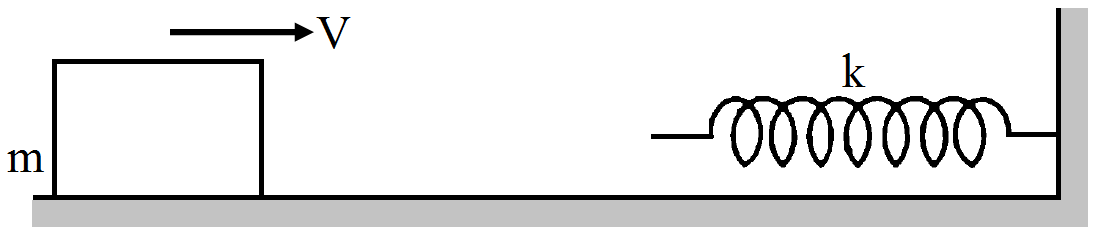
A block of massip, sliding on a smooth horizontal surface with a velocity $\vec{\text{v}}$ meets a long horizontal spring fixed at one end and having spring constant k as shown in figure. Find the maximum compression of tin spring. Will the velocity of the block be the same $\vec{\text{v}}$ when it comes back to the original position shown?