Question
The torque of a force $\overrightarrow{\text{F}}$ about a point is defined as $\overrightarrow{\text{r}}=\overrightarrow{\text{r}}\times\overrightarrow{\text{F}}.$ Suppose $\overrightarrow{\text{r}}, \overrightarrow{\text{F}}$and $\overrightarrow{\text{r}}$ are all nonzero. Is $\text{r}\times\overrightarrow{\text{r}}\Bigg|\Bigg|\overrightarrow{\text{F}}$ always true? Is it ever true?
Answer

No, $\overrightarrow{\text{r}}\times\overrightarrow{\text{r}}\Bigg|\Bigg|\overrightarrow{\text{r}}$ is not true. In fact, it is never true. This is because:$\overrightarrow{\text{r}}\times\overrightarrow{\text{r}}$
$=\overrightarrow{\text{r}}\times\Big(\overrightarrow{\text{r}}\times\overrightarrow{\text{F}}\Big)$
Applying vector triple product, we get:$\overrightarrow{\text{r}}\times\Big(\overrightarrow{\text{r}}\times\overrightarrow{\text{F}}\Big)$
$=\Big(\overrightarrow{\text{r}}.\overrightarrow{\text{F}}\Big)\overrightarrow{\text{r}}-\Big(\overrightarrow{\text{r}}.\overrightarrow{\text{r}}\Big)\overrightarrow{\text{F}}$
$\because\overrightarrow{\text{r}}.\overrightarrow{\text{r}}=\text{r}^2$
$=\Big(\overrightarrow{\text{r}}.\overrightarrow{\text{F}}\Big)\overrightarrow{\text{r}}-\text{r}^2\overrightarrow{\text{F}}$
If $\overrightarrow{\text{r}}.\overrightarrow{\text{F}}=0;$ that is, $\overrightarrow{\text{r}}\perp\overrightarrow{\text{F}},$ then:$\overrightarrow{\text{r}}\times\overrightarrow{\text{r}}=-\text{r}^2.\overrightarrow{\text{F}}$
We know that $r^2$ is never negative and $\overrightarrow{\text{r}}\times\overrightarrow{\text{r}}=-\text{r}^2.\overrightarrow{\text{F}}$ This implies that both vectors may be antiparallel to each other but not parallel.

Need a full question paper?

Generate a complete, print-ready paper with questions like this in minutes — across 16+ boards, with answer keys.

Start Generating Free

Similar questions

A bulb is made using two filaments. A switch selects whether the filaments are used individually or in parallel. When used with a 15V battery, the bulb can be operated at 5W, 10W or 15W. What should be the resistances of the filaments?
The separation between a node and the next antinode in a vibrating air column is 25cm. If the speed of sound in air is 340m/s, find the frequency of vibration of the air column.
The metre is defined as the distance travelled by light in $\frac{1}{299,792,458}$ second. Why didn't people choose some 1 easier number such as $\frac{1}{300,000,000}$ second? Why not 1 second?
Derive the equation of intensity of resultant wave generated due to super postion (or interference) of waves generated from two coherent sources.
Find the maximum angle of refraction when a light ray is refracted from glass $(\mu=1.50)$ to air.
A vertical rod is hit at one end. What kind of wave propagates in the rod if:
  1. The hit is made vertically.
  2. The hit is made horizontally?
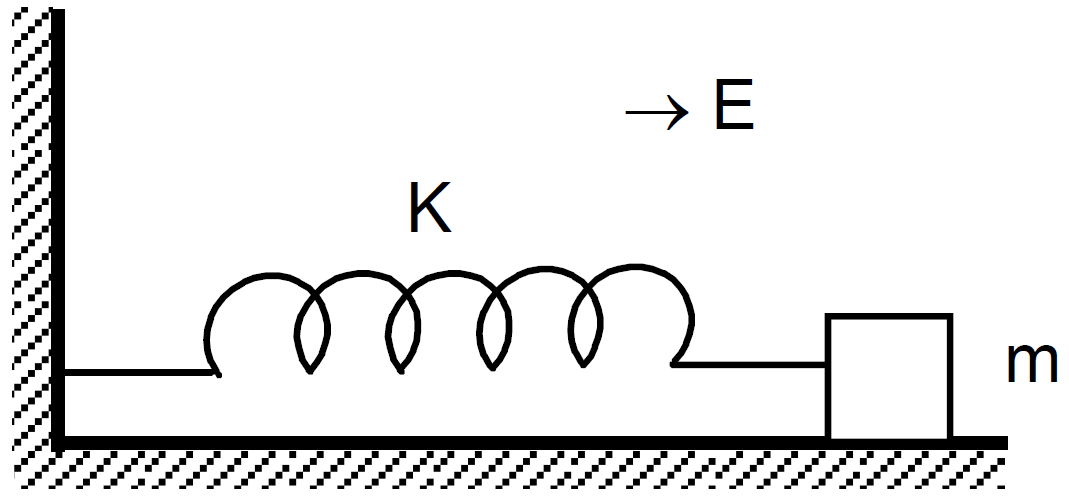
A block of mass m having a charge q is placed on a smooth horizontal table and is connected to a wall through an unstressed spring of spring constant k as shown in figure. A horizontal electric field E parallel to the spring is switched on. Find the amplitude of the resulting SHM of the block.
Suppose you are given a chance to repeat the alpha-particle scattering experiment using a thin sheet of solid hydrogen in place of the gold foil. (Hydrogen is a solid at temperatures below 14 K.) What results do you expect?
If an electric dipole is placed at an angle of $30^{\circ}$ to an electric field of intensity $2 \times 10^5 N / C$, a torque of 4 Nm is applied on it. If the length of the dipole is 2 cm , then what will be charge?
Answer the following questions:
An applied voltage signal consists of a superposition of a dc voltage and an ac voltage of high frequency. The circuit consists of an inductor and a capacitor in series. Show that the dc signal will appear across C and the ac signal across L.