Question
The total plane angle subtended by a circle at its centre is ......... $rad$

Answer

(b)

The total plane angle is $360^{\circ}$ or $2 \pi \,rad$.

Need a full question paper?

Generate a complete, print-ready paper with questions like this in minutes — across 16+ boards, with answer keys.

Start Generating Free

Similar questions

Which of the following is the example of ideal black body
The intensity of electric field required to balance a proton of mass $1.7 \times {10^{ - 27}} kg$ and charge $1.6 \times {10^{ - 19}} C$ is nearly
In a hydrogen discharge tube it is observed that through a given cross-section $3.13 \times {10^{15}}$ electrons are moving from right to left and $3.12 \times {10^{15}}$ protons are moving from left to right. What is the electric current in the discharge tube and what is its direction
A bubble has surface tension $S$. The ideal gas inside the bubble has ratio of specific heats $\gamma=\frac{5}{3}$. The bubble is exposed to the atmosphere and it always retains its spherical shape. When the atmospheric pressure is $P_{a 1}$, the radius of the bubble is found to be $r_1$ and the temperature of the enclosed gas is $T_1$. When the atmospheric pressure is $P_{a 2}$, the radius of the bubble and the temperature of the enclosed gas are $r_2$ and $T_2$, respectively.

Which of the following statement($s$) is(are) correct?

$(A)$ If the surface of the bubble is a perfect heat insulator, then $\left(\frac{r_1}{r_2}\right)^5=\frac{P_{a 2}+\frac{2 S}{r_2}}{P_{a 1}+\frac{2 S}{r_1}}$

$(B)$ If the surface of the bubble is a perfect heat insulator, then the total internal energy of the bubble including its surface energy does not change with the external atmospheric pressure.

$(C)$ If the surface of the bubble is a perfect heat conductor and the change in atmospheric temperature is negligible, then $\left(\frac{r_1}{r_2}\right)^3=\frac{P_{a 2}+\frac{4 S}{r_2}}{P_{a 1}+\frac{4 S}{r_1}}$.

$(D)$ If the surface of the bubble is a perfect heat insulator, then $\left(\frac{T_2}{T_1}\right)^{\frac{5}{2}}=\frac{P_{a 2}+\frac{4 S}{r_2}}{P_{a 1}+\frac{4 S}{r_1}}$.
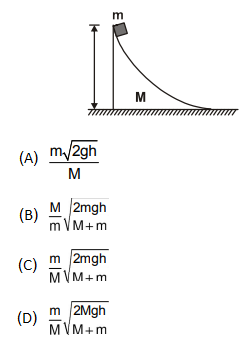
A mass m is placed at a height on the wedge of mass M shown in the figure. The ground is smooth. When the mass m reaches the ground, velocity of the wedge is (assume all smooth surfaces):
Image
Four light waves are represented by

(i) $y = a_1\, sin\omega\, t$ 

(ii) $y = {a_2}\sin (\omega \,t + \phi )$

(iii) $y = {a_1}\sin 2\omega \,t$         

(iv) $y = {a_2}\sin 2(\,\omega \,t + \phi )$

Interference fringes may be observed due to superposition of
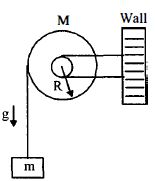
A uniform disc of radius $R$ and mass $M$ is free to rotate only about its axis. A string is wrapped over its rim and a body of mass $m$ is tied to the free end of the string as shown in the figure. The body is released from rest. Then the acceleration of the body is
A layer of oil $3\,cm$ thick is floating on a layer of coloured water $5\,cm$ thick. Refractive index of coloured water is $5/3$ and the apparent depth of the two liquids  appears to be $36/7\,cm.$ Find the refractive index of oil.
A gamma ray photon creates an electron positron pair. If the rest mass energy of an electron is $0.5\, MeV$ and the total kinetic energy of the electron positron of pair is $0.78\, MeV$, then the energy of the gamma ray photon must be......$MeV$
A light wave is incident normally over a slit of width $24 \times {10^{ - 5}}cm$. The angular position of second dark fringe from the central maxima is $30^{o}$. What is the wavelength of light............$\mathop A\limits^o $