MCQ
The transition metal ions responsible for colour in ruby and emerald are, respectively
  • A
    $Co^{3+}$ and $Cr^{3+}$
  • B
    $Co^{3+}$ and $Co^{3+}$
  • $Cr^{3+}$ and $Cr^{3+}$
  • D
    $Cr^{3+}$ and $Co^{3+}$

Answer

Correct option: C.
$Cr^{3+}$ and $Cr^{3+}$
c
A ruby is a crystal of alumina, aluminum oxide $(Al_2O_3)$ containing a trace of chromium $(III)$ ions replacing some of the aluminum ions. In ruby, each $Al^{3+}$ ion and $Cr^{3+}$ ion is surrounded by six oxide ions in an octahedral arrangement. The origin of the color of emeralds is similar to that of the color of rubies. However, the bulk of an emerald crystal is composed of beryl, beryllium aluminum silicate $(Be_3 Al_2(SiO_3)_6)$ instead of the alumina which forms rubies. The color is produced by chromium $(III)$ ions, which replace some of the aluminum ions in the crystal. In emeralds, the $Cr^{3+}$ is surrounded by six silicate ions, rather than the six oxide ions in ruby. Therefore, the color (green) of emeralds is different from that of ruby

Need a full question paper?

Generate a complete, print-ready paper with questions like this in minutes — across 16+ boards, with answer keys.

Start Generating Free

Similar questions

A nauseating smell in the carbylamine test for primary amines is due to the formation of
Starting from propanoic acid the following reactions were carried out as following $CH_3 - CH_2 - COOH$ $\xrightarrow{{SOC{l_2}}}\left[ X \right]\xrightarrow[\Delta ]{{N{H_3}}}\left[ Y \right]\xrightarrow[{KOH}]{{B{r_2}}}\left[ Z \right]$ Product $[Z]$ will be?
Trichloroacetaldehyde was subjected to Cannizzaro's reaction by using $NaOH.$ The mixture of the products contains sodium trichloroacetate and another compound. The other compound is :
$C_3H_6Br_2$ can shows :
Aspirin is obtained by the reaction of salicylic acid with
A solution of two miscible liquids showing negative deviation from Raoult's law will have :
Given that $E_{{K^ + }/K}^o\, = \, - \,2.93\,V\,;$

$E_{F{e^{2 + }}/Fe}^o\, = \, - \,0.44\,\,V\,;\,\,E_{Z{n^{2 + }}/Zn}^o\, = \, - \,0.76\,\,V\,;\,$

$E_{C{u^{ + 2}}/Cu}^o\, = \,0.34\,\,V$

Based on this data, which of the following is the strongest reducing agent ?
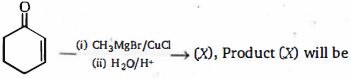
In the reaction sequence
For the reaction $A + B =2 C$, the speed of extinction of A is $10^{-2}$ mole litre 'second', then what will be the speed of formation of C ?
$1\,L,0.02\,M$ solution of $\left[ Co \left( NH _3\right)_5 SO _4\right] Br$ is mixed with $1\,L,0.02\,M$ solution of $\left[ Co \left( NH _3\right)_5 Br _3\right] SO _4$. The resulting solution is divided into two equal parts (X) and treated with excess $AgNO _3$ solution and $BaCl _2$ solution respectively as shown below:

$1\,L$ Solution $( X )+ AgNO _3$ solution (excess) $\rightarrow Y$

$1\,L$ Solution $( X )+ BaCl _2$ solution (excess) $\rightarrow Z$

The number of moles of $Y$ and $Z$ respectively are