MCQ
The trivalent ion having largest size in following is
  • A
    $Ti$
  • B
    $Zr$
  • C
    $Hf$
  • $La$

Answer

Correct option: D.
$La$
d
The Lanthanide series starts from $La$ and thus $La ^{3+}$ will have the largest size because we know on moving across the period from left to right the size decreases in Lanthanide and thus the same will be similar for the trivalent ions.

Need a full question paper?

Generate a complete, print-ready paper with questions like this in minutes — across 16+ boards, with answer keys.

Start Generating Free

Similar questions

Identify major product ?

$\begin{array}{*{20}{c}}
  {C{H_3} - CH - C{H_2} - COOH} \\ 
  {|\,\,\,\,\,\,\,\,\,\,\,\,\,\,\,\,\,\,\,\,\,\,\,\,\,} \\ 
  {C{H_3}\,\,\,\,\,\,\,\,\,\,\,\,\,\,\,\,\,\,\,} 
\end{array}\xrightarrow[{ + CaO}]{{NaOH}}$

In the Victor-Meyer's test, the colour given by $1^o, 2^o$ and $3^o$ alcohols are respectively
Tischenko reaction yields ester in the presence of catalyst which is
Two soluble salts of iron $A$ & $B$ , on combining with excess of a reagent $(R)$  reduces compound $C$(Pale yellow) & $D$ (yellow) respectively. Reaction of $A$ with $D$ and that of $B$ with $C$  both produce a blue coloured compound.

Which of the following statement would be correct?
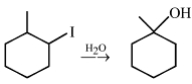
Which of the following intermediate is not expected to be formed in the following reaction ?
Which of the following does not respond to Fehling solution test and haloform reaction but show Cannizzaro's reaction
Which of the following anion does not produce precipitate with $BaCl_2$ solution however gives precipitate with $AgNO_3$ ?
The boiling point of $0.2 \,mol\, kg^{-1}$ solution of $X$ in water is greater than equimolal solution of $Y$ in water. Which one of the following statements is true in this case ?
In the presence of a catalyst, the heat evolved or absorbed during the reaction _______________
The conductance of a $0.0015 \mathrm{M}$ aqueous solution of a weak monobasic acid was determined by using a conductivity cell consisting of platinized $\mathrm{Pt}$ electrodes. The distance between the electrodes is $120 \mathrm{~cm}$ with an area of cross section of $1 \mathrm{~cm}^2$. The conductance of this solution was found to be $5 \times 10^{-7} \mathrm{~S}$. The $\mathrm{pH}$ of the solution is $4$ . The value of limiting molar conductivity $\left(\Lambda_{\mathrm{m}}^0\right)$ of this weak monobasic acid in aqueous solution is $\mathrm{Z} \times 10^2 \mathrm{~S} \mathrm{~cm}^{-1} \mathrm{~mol}^{-1}$. The value of $\mathrm{Z}$ is