Question
The true statement is

Answer

Primary rainbow is formed because of one total internal reflection and two refraction of white light by water droplet. A secondary rainbow appears outside of a primary rainbow and develops when light entering a raindrop undergoes two internal reflections.

Answer: The true statement is the intensity of light for different colour in primary rainbow is greater and the order of colour is reverse than the secondary rainbow.

Need a full question paper?

Generate a complete, print-ready paper with questions like this in minutes — across 16+ boards, with answer keys.

Start Generating Free

Similar questions

A wire elongates by $l$ $mm$ when a load $W$ is hanged from it. If the wire goes over a pulley and two weights $W$ each are hung at the two ends, the elongation of the wire will be (in $mm$)
The terminal voltage across a battery of $\mathrm{emf}$ $E$ can be
Assertion : A proton and an alpha particle having the same kinetic energy are moving in circular paths in a uniform magnetic field. The radii of their circular paths will be equal.

Reason : Any two charged particles having equal kinetic energies and entering a region of uniform magnetic field $\overrightarrow B $ in a direction perpendicular to $\overrightarrow B $, will describe circular trajectories of equal radii.
A simple harmonic oscillator has an amplitude a and time period $T$. The time required by it to travel from $x = a$ to $x = \frac{a }{2}$ is
For ordinary terrestrial experiments, the observer in an inertial frame in the following cases is
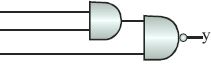
The output $y$, when all three inputs are first high and then low, will respectively be
Which of the following equations is dimensionally incorrect?

Where $t=$ time, $h=$ height, $s=$ surface tension, $\theta=$ angle, $\rho=$ density, $a, r=$ radius, $g=$ acceleration due to gravity, ${v}=$ volume, ${p}=$ pressure, ${W}=$ work done, $\Gamma=$ torque, $\varepsilon=$ permittivity, ${E}=$ electric field, ${J}=$ current density, ${L}=$ length.

A point source of light is moving at a rate of $2 \,cms ^{-1}$ towards a thin convex lens of focal length $10 \,cm$ along its optical axis. When the source is $15 \,cm$ away from the lens, the image is moving at
A particle is acted upon by a force of constant magnitude which is always perpendicular to the velocity of the particle. The motion of the particle takes place in a plane. It follows that  
Which of the following processes involves the principle of electrostatic induction?