The two bulbs as in the above question are connected in series to a $200\, volt$ line. Then
Easy


Download our appand get started for free
Experience the future of education. Simply download our apps or reach out to us for more information. Let's shape the future of learning together!No signup needed.*
Similar Questions
- 1View SolutionWhich of the following has a negative temperature coefficient
- 2Two wires of the same dimensions but resistivities ${\rho _1}$ and ${\rho _2}$ are connected in series. The equivalent resistivity of the combination isView Solution
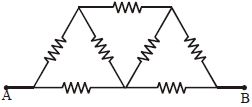
- 3In the network shown in the following figure, each resistance is $1\,ohm.$ The effective resistance between $A$ and $B$ isView Solution
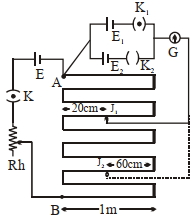
- 4In the given circuit of potentiometer, the potential difference $E$ across $AB$ ( $10\, m$ length) is larger than $E _{1}$ and $E _{2}$ as well. For key $K _{1}$ (closed), the jockey is adjusted to touch the wire at point $J_{1}$ so that there is no deflection in the galvanometer. Now the first battery $\left( E _{1}\right)$ is replaced by second battery $\left( E _{2}\right)$ for working by making $K _{1}$ open and $K _{2}$ closed. The galvanometer gives then null deflection at $J _{2}$. The value of $\frac{ E _{1}}{ E _{2}}$ is $\frac{ a }{ b },$ where $a =$ ...............View Solution
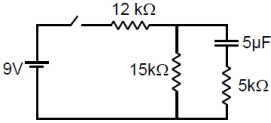
- 5Find charge on the capacitor after $1$ sec of opening the switch at $t=\infty ?$View Solution
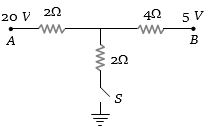
- 6As the switch $S$ is closed in the circuit shown in figure, current passed through it is .................. $A$View Solution
- 7Find current in $6\,\Omega $ resistanceView Solution
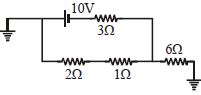
- 8The total current supplied to the circuit by the battery is ............. $A$View Solution
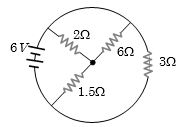
- 9What is the equivalent resistance between the points $A$ and $B$ of the network .................. $\Omega$View Solution
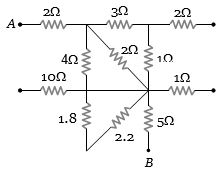
- 10At what rate the potential difference between the plates of a capacitor be changed to set up a displacement current of $1\, A$ in a capacitor of $2\,\mu F$ ?View Solution