Question
The two graphs are drawn below, show the variations of electrostatic potential (V) $\frac{1}{\text{r}}$ (r being the distance of field point from the point charge) for two point charges q1 and q2.
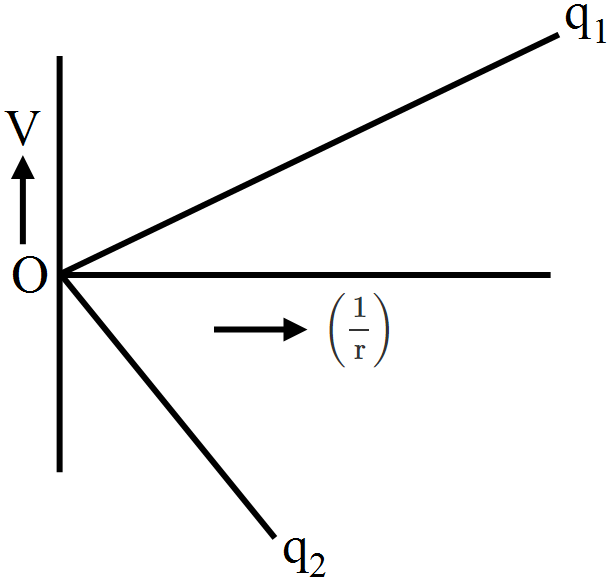
  1. What are the signs of the two charges?
  2. Which of the two charges has the larger magnitude and why?
​​​​​​​​​​​​​​

Answer

  1. The potential due to positive charge is positive and due to negative charge, it is negative, so, is q1 positive and q2 is negative.

$\text{V}=\frac{1}{4\pi\varepsilon_0}\frac{\text{q}}{\text{r}}$

  1. The graph between V and $\frac{1}{\text{r}}$ is a straight line passing through the origin with slope $\frac{\text{q}}{4\pi\varepsilon_0},$

As the magnitude of slope of the line due to charge q2 is greater than that due to q1, q2 has larger magnitude.

Need a full question paper?

Generate a complete, print-ready paper with questions like this in minutes — across 16+ boards, with answer keys.

Start Generating Free

Similar questions

When can a charge act as a source of electromagnetic wave? How are the directions of electric and magnetic field vectors, in an electromagnetic wave related to each other and to the direction of propagation of the wave?
Which physical quantity, if any, has the same value for waves belonging to the different parts of the electromagnetic spectrum?
When you hold a pen and write on your notebook, what kind of force is exerted by you on the pen? By the pen on the notebook? By you on the notebook?
For a CE-transistor amplifier, the audio signal voltage across the collector resistance of 2 k$\Omega$ is 2 V. suppose the current amplification factor if the transistor is 100, find the input signal voltage and base current if the base resistance is 1 k$\Omega$.
A man is sitting on the shore of a river. He is in the line of a 1.0m long boat and is 5.5m away from the centre of the boat. He wishes to throw an apple into the boat. If he can throw the apple only with a speed of 10m/s, find the minimum and maximum angles of projection for successful shot. Assume that the point of projection and the edge of the boat are in the same horizontal level.
What is forward bias ? Explain the change happening in the junction under the effect of forward bias.
The four arms of a Wheatstone bridge (Fig. 3.19) have the following resistances:
$
AB =100 \Omega, BC =10 \Omega, CD =5 \Omega \text {, and } DA =60 \Omega \text {. }
$
Image
A galvanometer of $15 \Omega$ resistance is connected across BD. Calculate the current through the galvanometer when a potential difference of $10 V$ is maintained across AC.
A 10cm long rod carries a charge of $+50\mu\text{C}$ distributed uniformly along its length. Find the magnitude of the electric field at a point 10cm from both the ends of the rod.
  1. A radioactive nucleus 'A' undergoes a series of decays as given below:

$\text{A}\xrightarrow\alpha\text{A}_1\xrightarrow\beta\text{A}_2\xrightarrow\alpha\text{A}_3\xrightarrow\gamma\text{A}_4$

The mass number and atomic number of A2 are 176 and 71 respectively. Determine the mass and atomic numbers of A4 and A.

  1. Write the basic nuclear process underlying $\beta+$ and $\beta-$ decays.
The electrostatic force on a small sphere of charge 0.4 μC due to another small sphere of charge –0.8 μC in air is 0.2 N.
  1. What is the distance between the two spheres?
  2. What is the force on the second sphere due to the first?
The stopping potential in a photoelectric experiment is linearly related to the inverse of the wavelength $\Big(\frac{1}{\lambda}\Big)$ of the light falling on the cathode. The potential difference applied across an X-ray tube is linearly related to the inverse of the cutoff wavelength$\Big(\frac{1}{\lambda}\Big)$ of the X-ray emitted. Show that the slopes of the lines in the two cases are equal and find its value.