MCQ
The type of bonding in $HCl$ molecule is
  • A
    Pure covalent
  • Polar covalent
  • C
    Highly covalent
  • D
    $H$ - bonding

Answer

Correct option: B.
Polar covalent
b
It’s Obvious.

Need a full question paper?

Generate a complete, print-ready paper with questions like this in minutes — across 16+ boards, with answer keys.

Start Generating Free

Similar questions

Assertion : On increasing dilution, the specific conductance keep on increasing.

Reason : On increasing dilution, degree of ionisation of weak electrolyte increases and molality of ions also increases.
The correct order of ligands in the spectrochemical series is
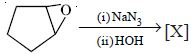
In the given reaction $[X]$ will be :
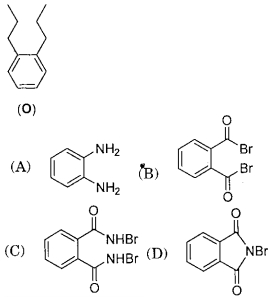
Treatment of compound $O$ with $KMnO_4 / \mathrm{H}^{+}$gave $P$, which on heating with ammonia gave $Q$. The compound $Q$ on treatment with $Br_2 / NaOH$ produced $R$. On strong heating, $Q$ gave $S$, which on further treatment with ethyl $2$-bromopropanoate in the presence of $KOH$ followed by acidification, gave a compound $T$.

(image)

($1$) The compound $R$ is

(image)

($2$) The compound $T$ is

($A$) glycine

($B$) alanine

($C$) valine

($D$) serine

Given the answer question ($1$) and ($2$) 
Assertion :Nitrobenzene is used as a solvent in Friedel-Craft's reaction.
Reason : Fusion of nitrobenzene with solid $KOH$ gives a low yield of a mixture of $o-$ and $p-$ nitrophenols
In electrolysis of aq.$NiI_2$ solution using $Ni$ electrodes on passing $1$ equivalent charge, mass of cathode Given $[Ni = 59, I = 127]$
For an elementary reaction, $2A + B \to   C + D$ the molecularity is
Arrange the following in increasing order of basicity $C{H_3}N{H_2},\,\,{(C{H_3})_2}NH,\,{C_6}{H_5}N{H_2},\,{(C{H_3})_3}N$
Assertion : White phosphorus is more reactive than red phosphorus.

Reason : Red phosphorus consists of $P_4$ tetrahedral units linked to one another to form linear chains.

Find out which of the following statement are true & False

$(a)$ Number of $S-S$ bonds in $H_2S_nO_6$ are $(n +1)$

$(b)$ When $F_2$ reacts with $H_2O$ it forms $HF,$ $O_2$ & $O_3.$

$(c)$ $XeF_6$ on hydrolysis shows disproportionation reaction

$(d)$ $Al$ metal on reacting with dilute $NaOH$ gives a white precipitate of $Al (OH)_3$ as a final product