Question
The uniform field between the plates of a parallel plate capacitor is E volt/meter. If the distance between the plates is $d ( m )$ and the area of each plate is $A \left( m ^2\right)$, then the total energy stored in it is :

Answer

(a)$\frac{1}{2} \epsilon_0 E ^2 A d$

Need a full question paper?

Generate a complete, print-ready paper with questions like this in minutes — across 16+ boards, with answer keys.
Start Generating Free

Similar questions

At the magnetic North Pole of the Earth, what is the value of the angle of dip?
Corpuscles are the tiny particles of:
A 10 micro-farad capacitor is charged to 500 V and then its plates are joined together through a resistance of 10 ohm. The heat produced in the resistance is(a) 500 J  (b) 250 J(c) 125 J  (d) 1.25 J
       
If the refractive indices of crown glass for red, yellow and violet colours are 1.5140, 1.5170 and 1.5318 respectively and for flint glass these are 1.6434, 1.6499 and 1.6852 respectively, then the dispersive powers for crown and flint glass are respectively(a) 0.034 and 0.064(b) 0.064 and 0.034(c) 1.00 and 0.064(d) 0.034 and 1.0
       
The wavelength of a photon needed to remove a proton from a nucleus which is bound to the nucleus with $1\ MeV$ energy is nearly:
Light enters at an angle of incidence in a transparent rod of refractive index $n.$ For what value of the refractive index of the material of the rod the light once entered into it will not leave it through its lateral face whatsoever be the value of angle of incidence
Which of the following values of n is not possible in relation $ Q=ne $ :
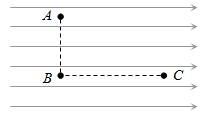
Figure shows three points $A, B$ and $C$ in a region of uniform electric field $\vec{E}$. The line $A B$ is perpendicular and $B C$ is parallel to the field lines. Then which of the following holds good. Where $V_A, V_B$ and $V_C$ represent the electric potential at points $A, B$ and $C$ respectively
If the wavelength of light in an experiment on photoelectric effect is doubled:
Light wave enters from medium $1$ to medium $2.$ Its velocity in $ 2^{\text {nd }}$ medium is double from $1^{\text {st }}$. For total internal reflection the angle of incidence must be greater than