MCQ
The unit of $e.m.f.$ is
  • A
    Joule
  • B
    Joule-Coulomb
  • C
    Volt-Coulomb
  • Joule/Coulomb

Answer

Correct option: D.
Joule/Coulomb
d
(d) Unit of $e.m.f.$ = volt = joule/coulomb

Need a full question paper?

Generate a complete, print-ready paper with questions like this in minutes — across 16+ boards, with answer keys.
Start Generating Free

Similar questions

What is the intensity of gravitational field of the centre of a spherical shell
A particle moves so that its position vector is given by $\overrightarrow {\;r} = cos\omega t\,\hat x + sin\omega t\,\hat y$ , where $\omega$ is a constant.  Which of the following is true?  
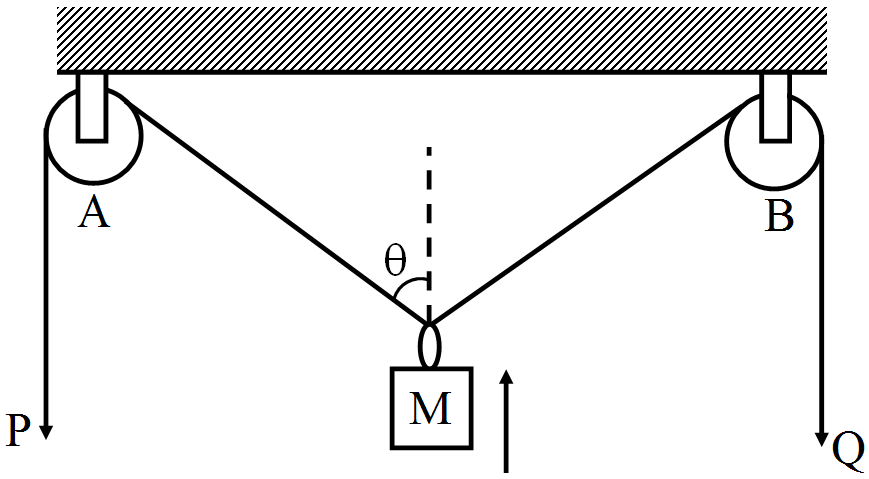
In the arrangement shown in figure, the ends P and Q of an inextensible string move downwards with uniform speed u. Pulleys A and B are fixed. The mass M moves upwards with a speed:
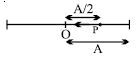
A particle starts from a point $P$ at a distance of $A/2$ from the mean position $O\, \&$ travels towards left as shown in the figure. If the time period of $SHM,$ executed about $O$ is $T$ and amplitude $A$ then the equation of motion of particle is :
A cylinder rolls down two different inclined planes of the same height but of different inclinations
If a spring extends by $x$ on loading, then energy stored by the spring is (if $T$ is the tension in the spring and $K$ is the spring constant)
The particles $A$ and $B$ of mass $m$ each are separated by a distance $r$. Another particle $C$ of mass $M$ is placed at the midpoint of $A$ and $B$. Find the work done in taking $C$ to a point equidistant $r$ from $A$ and $B$ without acceleration $(G=$ Gravitational constant and only gravitational interaction between $A, B$ and $C$ is considered) 
A brass rod of length $2\,m$ and cross-sectional area $2.0\,cm^2$ is attached end to end to a steel rod of length $L$ and cross-sectional area $1.0\,cm^2$ . The compound rod is subjected to equal and opposite pulls of magnitude $5 \times 10^4\,N$ at its ends. If the elongations of the two rods are equal, then length of the steel rod $(L)$ is ........... $m$ $(Y_{Brass}=1.0\times 10^{11}\,N/m^2$ and $Y_{Steel} = 2.0 \times 10^{11}\,N/m^2)$
An object will continue moving uniformly until
Two drops of the same radius are falling through air with a steady velocity of $5 cm per sec.$  If the two drops coalesce, the terminal velocity would be