MCQ
The unit of $e.m.f.$ is
  • A
    Joule
  • B
    Joule-Coulomb
  • C
    Volt-Coulomb
  • Joule/Coulomb

Answer

Correct option: D.
Joule/Coulomb
d
(d) Unit of $e.m.f.$ = volt = joule/coulomb

Need a full question paper?

Generate a complete, print-ready paper with questions like this in minutes — across 16+ boards, with answer keys.
Start Generating Free

Similar questions

The second's hand of a watch has $6\, cm$ length. The speed of its tip and magnitude of difference in velocities of its at any two perpendicular positions will be respectively
A body freely falling from the rest has a velocity v after his falls through a height h. The distance, it has to fall down further for its velocity to become double, is:
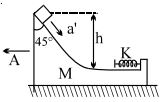
$A$ small block of mass $m$ is placed on $a$ wedge of mass $M$ as shown, which is initially at rest. All the surfaces are frictionless . The spring attached to the other end of wedge has force constant $k$. If $a'$ is the acceleration of $m$ relative to the wedge as it starts coming down and $A$ is the acceleration acquired by the wedge as the block starts coming down, then 
A block of mass $10\, kg$ accelerates uniformly from rest to a speed of $2\, m/s$ in $20\, sec$. The average power developed in time interval of $0$ to $20\, sec$ is .............. $\mathrm{W}$
Beats are produced by two waves ${y_1} = a\sin 1000\,\pi t,$ ${y_2} = a\sin 998\pi t$The number of beats heard/sec is
The surface area of a solid cylinder of radius 2.0cm and height A cm is equal to 1.5 × 104(mm)2. Here, A refers to:
The ratio of kinetic energy of a planet at perigee and apogee during its motion around the sun in elliptical orbit of eccentricity $e$ is ..........
Huygens' principle of secondary wavelets may be used to:
  1. Find the velocity of light in vacuum.
  2. Explain the particle behaviour of light.
  3. Find the new position of a wavefront.
  4. Explain Snell's law.
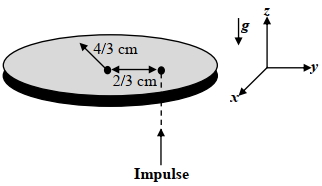
A thin circular coin of mass $5 \mathrm{gm}$ and radius $4 / 3 \mathrm{~cm}$ is initially in a horizontal $x y$-plane. The coin is tossed vertically up ( $+z$ direction) by applying an impulse of $\sqrt{\frac{\pi}{2}} \times 10^{-2} \mathrm{~N}-\mathrm{s}$ at a distance $2 / 3 \mathrm{~cm}$ from its center. The coin spins about its diameter and moves along the $+z$ direction. By the time the coin reaches back to its initial position, it completes $n$ rotations. The value of $n$ is. . . . . [Given: The acceleration due to gravity $\mathrm{g}=10 \mathrm{~ms}^{-2}$ ]
An object is moving with an initial velocity of 30ms-1 with uniform acceleration. The velocity of object increases to 40ms-1 in next 5s. The v-t graph which least represents this situation is: