MCQ
The unit of "impulse per unit area" is same as that of
  • Viscosity
  • B
    Surface tension
  • C
    Bulk modulus
  • D
    Force

Answer

Correct option: A.
Viscosity
a
(a)

$\frac{\text { Impulse }}{\text { Area }}=\frac{M L T^{-1}}{L^2} \Rightarrow\left[ ML ^{-1} T ^{-1}\right]$

Coefficient of viscosity $\Rightarrow \eta=\left[ ML ^{-1} T^{-1}\right]$

So, $\frac{\text { Impulse }}{\text { Area }}=$ coefficient of viscosity

Need a full question paper?

Generate a complete, print-ready paper with questions like this in minutes — across 16+ boards, with answer keys.
Start Generating Free

Similar questions

A body of mass 400g connected to a spring with spring constant 10Nm-1, executes simple harmonic motion, time period of oscillation is
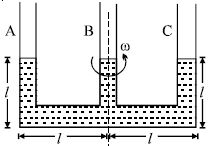
Figure shows a three arm tube in which a liquid is filled upto levels of height $l$. It is now rotated at an angular frequency $\omega$ about an axis passing through arm $B$. The angular frequency $\omega$ at which level of liquid in arm $B$ becomes zero. 
The moment of inertia of a rod about an axis through its centre and perpendicular to it is $\frac{1}{{12}}\,M{L^2}$ (where $M$ is the mass and $L$, the length of the rod). The rod is bent in the middle so that the two halts make an angle of $60^o$. The moment of inertia of the bent rod about the same axis would be 
A particle of mass m is executing oscillation about the origin about the origin on the x-axis, its potential energy is U = kx3, where k is a positive constant. If the amplitude of oscillation is a, then its time period T is:
A rod of length $l$ is hinged from one end. It is brought to a horizontal position and released. The angular velocity of the rod when it is in the vertical position is
For $z=a^{2} x^{3} y^{\frac{1}{2}}$, where $a$ is a constant. If percentage error in measurement of $x$ and $y$ are $4 \%$ and $12 \%$, respectively, then the percentage error for $z$ will be $%$
Two cars $A$ and $B$ are moving with same speed of $45\,km/h$ along same direction. If a third car $C$ coming from the opposite direction with a speed of $36\,km/h$ meets two cars in an interval of $5\,min,$ the distance of separation of two cars $A$ and $B$ should be.......$km$
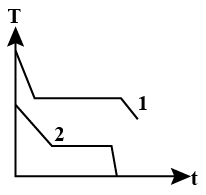
Two different liquids of same mass are kept in two identical vessels, which are placed in a freezer that extracts heat from them at the same rate causing each liquid to transform into a solid. The schematic figure below shows the temperature $T$ versus time $t$ plot for the two materials. We denote the specific heat in the liquid states to be $C_{L 1}$ and $C_{L 2}$ for materials 1 and 2, respectively and latent heats of fusion $U_1$ and $U_2$, respectively. Choose the correct option.
A body of mass $m= 10^{-2}$ $kg$ is moving in a medium and experiences a frictional force $F= -kv^2$. Its initial speed is $v_0= 10$ $ms^{-1}$. If, after $10\; s$, its energy is $\frac{1}{8}$ $mv_0^2$ the value of $k$ will be
A uniform metal rod of $2\, mm^2$ cross section fixed between two walls is heated from $0\,^oC$ to $20\,^oC$. The coefficient of linear expansion of rod is $12\times10^{-6}/^oC$. Its Young's modulus of elasticity is $10^{11} \,N/m^2$. The energy stored per unit volume of rod will be ....... $J/m^3$