MCQ
The unit of Stefan's constant $\sigma $ is
  • A
    $W\,{m^{ - 2}}\,{K^{ - 1}}$
  • B
    $W\,{m^2}\,{K^{ - 4}}$
  • $W\,{m^{ - 2}}\,{K^{ - 4}}$
  • D
    $W\,{m^{ - 2}}\,{K^4}$

Answer

Correct option: C.
$W\,{m^{ - 2}}\,{K^{ - 4}}$
c
(c) Stefan's law is $E = \sigma ({T^4})$ 

$⇒$ $\sigma = \frac{E}{{{T^4}}}$

where,$E = $ $\frac{{{\rm{Energy}}}}{{{\rm{Area}} \times {\rm{Time}}}}$ $ = \frac{{{\rm{Watt}}}}{{{m^{\rm{2}}}}}$

$\sigma = \frac{{{\rm{Watt - }}{m^{ - 2}}}}{{{K^4}}} = Watt - {m^{ - 2}}{K^{ - 4}}$

Need a full question paper?

Generate a complete, print-ready paper with questions like this in minutes — across 16+ boards, with answer keys.
Start Generating Free

Similar questions

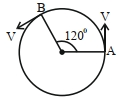
As shown in the figure, a particle is moving with constant speed $\pi\,m / s$. Considering its motion from $A$ to $B$, the magnitude of the average velocity is:
The force is given in terms of time $t$ and displacement $x$ by the equation

${F}={A} \cos {Bx}+{C} \sin {Dt}$

The dimensional formula of $\frac{{AD}}{{B}}$ is -
The unit of angular acceleration in the SI system is
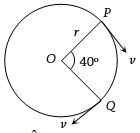
A particle is moving on a circular path of radius $r$ with uniform velocity $v$. The change in velocity when the particle moves from $P$ to $Q$ is $(\angle POQ = 40^\circ )$
From a tower of height $H$, a particle is thrown vertically upwards with a speed $ u$. The time taken by the particle, to hit the ground, is $n$ times that taken by it to reach the highest point of its path. The relation between $H, u$ and $n$ is:
If the measurement errors in all the independent quantities are known, then it is possible to determine the error in any dependent quantity. This is done by the use of series expansion and truncating the expansion at the first power of the error. For example, consider the relation $z=x / y$. If the errors in $x, y$ and $z$ are $\Delta x, \Delta y$ and $\Delta z$, respectively, then

$z \pm \Delta z=\frac{x \pm \Delta x}{y \pm \Delta y}=\frac{x}{y}\left(1 \pm \frac{\Delta x}{x}\right)\left(1 \pm \frac{\Delta y}{y}\right)^{-1} .$

The series expansion for $\left(1 \pm \frac{\Delta y}{y}\right)^{-1}$, to first power in $\Delta y / y$, is $1 \mp(\Delta y / y)$. The relative errors in independent variables are always added. So the error in $z$ will be $\Delta z=z\left(\frac{\Delta x}{x}+\frac{\Delta y}{y}\right)$.

The above derivation makes the assumption that $\Delta x / x \ll<1, \Delta y / y \ll<1$. Therefore, the higher powers of these quantities are neglected.

($1$) Consider the ratio $r =\frac{(1- a )}{(1+ a )}$ to be determined by measuring a dimensionless quantity a.

If the error in the measurement of $a$ is $\Delta a (\Delta a / a \ll<1)$, then what is the error $\Delta r$ in

$(A)$ $\frac{\Delta a }{(1+ a )^2}$  $(B)$ $\frac{2 \Delta a }{(1+ a )^2}$  $(C)$ $\frac{2 \Delta a}{\left(1-a^2\right)}$  $(D)$ $\frac{2 a \Delta a}{\left(1-a^2\right)}$

($2$) In an experiment the initial number of radioactive nuclei is $3000$ . It is found that $1000 \pm$ 40 nuclei decayed in the first $1.0 s$. For $|x|<1$, In $(1+x)=x$ up to first power in $x$. The error $\Delta \lambda$, in the determination of the decay constant $\lambda$, in $s ^{-1}$, is

$(A) 0.04$  $(B) 0.03$  $(C) 0.02$  $(D) 0.01$

Give the answer or quetion ($1$) and ($2$)
Two discs of moments of inertia $I_1$ and $I_2$ about their respective axes (normal to  the disc and passing through the centre), and rotating with angular speed $\omega _1$ and $\omega _2$ are  brought into contact face to face with their axes of rotation coincident. What is the  loss in kinetic energy of the system in the process ?
Find the change in the entropy in the following process $100 \,gm$ of ice at $0°C$ melts when dropped in a bucket of water at $50°C$ (Assume temperature of water does not change) ..... $ cal/K$
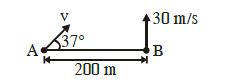
Two particles $A$ and $B$ are moving in horizontal plane as shown in figure at $t = 0$ , then time after which $A$ will catch $B$ will be.......$s$
Consider a rubber ball freely falling from a height $h =4.9\ m$ onto a horizontal elastic plate. Assume that the duration of collision is negligible and the collision with the plate is totally elastic.

Then the velocity as a function of time and the height as a function of time will be