MCQ
The universal property of all substances is
  • Diamagnetism
  • B
    Ferromagnetism
  • C
    Paramagnetism
  • D
    All of these

Answer

Correct option: A.
Diamagnetism

Need a full question paper?

Generate a complete, print-ready paper with questions like this in minutes — across 16+ boards, with answer keys.

Start Generating Free

Similar questions

The apparent depth of water in cylindrical water tank of diameter $2 R \mathrm{~cm}$ is reducing at the rate of $x \mathrm{~cm} /$ minute when water is being drained out at a constant rate. The amount of water drained in c.c. per minute is ( $n=$ refractive index of air, $n=$ refractive index of water)
A $50 \mathrm{~g}$ bullet moving with velocity $10 \mathrm{~m} / \mathrm{s}$ strikes a block of mass $950 \mathrm{~g}$ at rest and gets embedded in it. The loss in kinetic energy will be
In the process of electrolysis, the current is carried out inside the electrolyte by
In an isothermal process the volume of an ideal gas is halved. One can say that
For protecting a sensitive equipment from the external magnetic field, it should be
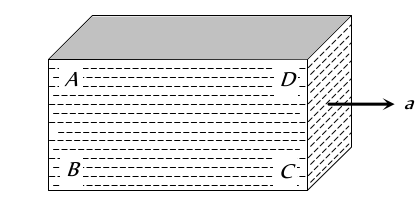
A closed rectangular tank is completely filled with water and is accelerated horizontally with an acceleration a towards right. Pressure is (i) maximum at, and (ii) minimum at Image
A satellite of mass $m$ is circulating around the earth with constant angular velocity. If radius of the orbit is $R_0$ and mass of the earth $M$, the angular momentum about the centre of the earth is
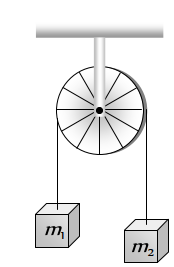
Two masses $m_1=5 kg$ and $m_2=4.8 kg$ tied to a string are hanging over a light frictionless pulley. What is the acceleration of the masses when they are free to move $\left(g=9.8 m / s ^2\right)$
Image
A marble block of mass $2 \mathrm{~kg}$ lying on ice when given a velocity of $6 \mathrm{~m} / \mathrm{s}$ is stopped by friction in $10 \mathrm{~s}$. Then the coefficient of friction is
Amount of heat required to raise the temperature of a body through $1 K$ is called its