MCQ
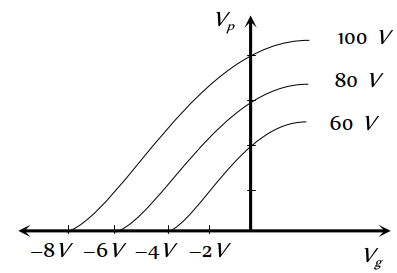
The value of amplification factor from the following graph will beImage
  • $10$
  • B
    $50$
  • C
    $25$
  • D
    $40$

Answer

Correct option: A.
$10$
$\mu=-\left(\frac{\Delta V_p}{\Delta V_g}\right)_{\Delta i_p=\text { const. }}=\frac{-(80-60)}{[-6-(-4)]}=\frac{20}{2}=10$

Need a full question paper?

Generate a complete, print-ready paper with questions like this in minutes — across 16+ boards, with answer keys.
Start Generating Free

Similar questions

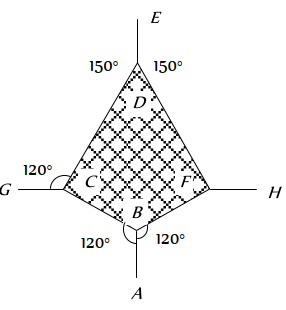
The adjacent figure is the part of a horizontally stretched net. section $A B$ is stretched with a force of $10 N$. The tensions in the sections $B C$ and $B F$ are
Which of the following group have different dimension
The volume of an air bubble becomes three times as it rises from the bottom of a lake to its surface. Assuming atmospheric pressure to be $75 cm$ of $Hg$ and the density of water to be $1 / 10$ of the density of mercury, the depth of the lake is
In a medium sound travels $2 \mathrm{~km}$ in $3\  \mathrm{sec}$ and in air, it travels $3 \mathrm{~km}$ in $10 \ \mathrm{sec}$. The ratio of the wavelengths of sound in the two media is
A bar magnet having centre $O$ has a length of $4 \mathrm{~cm}$. Point $P$ is in the broad side-on and $P$ is in the end side-on position with $O P=$ $O P=10$ metres. The ratio of magnetic intensities $H$ at $P$ and $P$ is
Where $A$ and $K$ are positive constants A body is vibrating in simple harmonic motion with an amplitude of $0.06 m$ and frequency of $15 Hz$. The velocity and acceleration of body is
A particle which is constrained to move along the $x$-axis, is subjected to a force in the same direction which varies with the distance $x$ of the particle from the origin as $F(x)=-k x+a x^3$. Here $k$ and $a$ are positive constants. For $x \geq 0$, the functional from of the potential energy $U(x)$ of the particle is
$2 \mathrm{~kg}$ of ice at $-20^{\circ} \mathrm{C}$ is mixed with $5 \mathrm{~kg}$ of water at $20^{\circ} \mathrm{C}$ in an insulating vessel having a negligible heat capacity. Calculate the final mass of water remaining in the container. It is given that the specific heats of water and ice are $1 \mathrm{kcal} / \mathrm{kg}$ per ${ }^{\circ} \mathrm{C}$ and $0.5 \mathrm{kcal} / \mathrm{kg} /{ }^{\circ} \mathrm{C}$ while the latent heat of fusion of ice is $80 \mathrm{kcal} / \mathrm{kg}$
An ideal heat engine working between temperature $T$ and $T$ has an efficiency $\eta$, the new efficiency if both the source and sink temperature are doubled, will be
A sound source is moving towards a stationary observer with $1 / 10$ of the speed of sound. The ratio of apparent to real frequency is