MCQ
The value of $\int\limits_0^2 {\frac{{dx}}{{{{(1 - x)}^2}}}} $ is
  • A
    $-2$
  • B
    $0$
  • C
    $15$
  • indeterminate

Answer

Correct option: D.
indeterminate
d
$\int\limits_0^2 {\frac{{dx}}{{{{(1 - x)}^2}}}} $ $= \int\limits_0^{{1^ - }} {\frac{{dx}}{{{{(1 - x)}^2}}}} \,\, + \,\,\int\limits_{{1^ + }}^2 {\frac{{dx}}{{{{(1 - x)}^2}}}} \,$

$= \left. {\frac{1}{{1 - x}}} \right]_0^{{1^ - }}\,\, + \,\,\left. {\frac{1}{{1 - x}}} \right]_{{1^ + }}^2$

$= (\infty - 1) + (-1) - (- \infty ) \Rightarrow$ indeterminant

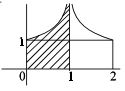
Note that the shaded area is divergent 
Need a full question paper?

Generate a complete, print-ready paper with questions like this in minutes — across 16+ boards, with answer keys.

Start Generating Free

Similar questions

The maximum number of equivalence relations on the set $A=\{1,2,3\}$ are
The value of the integral $\int\limits^2_{-2}\big|1-\text{x}^2\big|\text{dx}$ is:
If $\text{f(x)}=\begin{cases}\frac{1-\cos10\text{x}}{\text{x}^2},&\text{x}<0\\\text{a},&\text{x}=0\\\frac{\sqrt{\text{x}}}{\sqrt{625+\sqrt{\text{x}}}-25},&\text{x}>0\end{cases}$ then the value of so that f(x) may be continuous at x = 0 is:
Let $f\left( n \right) = \left[ {\frac{1}{3} + \frac{{3n}}{{100}}} \right]n$ , where $[n]$ denotes the greatest integer less than or equal to $n$. Then $\sum\limits_{n = 1}^{56} {f\left( n \right)} $ is equal to
Find the area of the triangle whose vertices are $(-2,6),(3,-6)$ and $(1,5)$.
The area of the region bounded by the parabola $y = x^2 + 1$ and the straight line $x + y = 3$ is given by:
Which of the following functions from $\text{A}=\{\text{x}:-1\leq\text{x}\leq1\}$ to itself are bijections?
Let $O$ be the origin. Let $\overline{ OP }= x \hat{ i }+ y \hat{ j }-\hat{ k }$ and $\overline{ OQ }=-\hat{ i }+2 \hat{ j }+3 x \hat{ k }, x , y \in R , x >0,$ be such that $|\overline{ PQ }|=\sqrt{20}$ and the vector $\overline{ OP }$ is perpendicular to $\overline{ OQ }$. If $\overline{ OR }=3 \hat{ i }+ z \hat{ j }-7 \hat{ k }, z \in R ,$ is coplanar with $\overline{ OP }$ and $\overline{ OQ },$ then the value of $x ^{2}+ y ^{2}+ z ^{2}$ is equal to ...... .
If $\tan^{-1}\Big\{\frac{\sqrt{1+\text{x}^2}-\sqrt{1-\text{x}^2}}{\sqrt{1+\text{x}^2}+\sqrt{1-\text{x}^2}}\Big\}=\alpha,$ then $x^2 =$
If $f(x)=2|x-2|-3|x-3|$ then $f(x)$ equals to, for 2 $< x< 3$.