MCQ
The value of R in SI unit will be:
  • A
    2 calories/mol-K
  • B
    8.3 joule/mole-K
  • C
    2 Kcal/kg mol-K
  • $8.3 \times 10^3$ joule $/ \text {kg mol} - K$

Answer

Correct option: D.
$8.3 \times 10^3$ joule $/ \text {kg mol} - K$
D

Need a full question paper?

Generate a complete, print-ready paper with questions like this in minutes — across 16+ boards, with answer keys.
Start Generating Free

Similar questions

From a stationary tank of mass $125000$ pound a small shell of mass $25$ pound is fired with a muzzle velocity of $1000\, ft/sec$. The tank recoils with a velocity of ............ $\mathrm{ft/sec}$
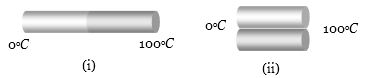
Two identical square rods of metal are welded end to end as shown in figure $(i)$ , $20$ calories of heat flows through it in $4$ minutes. If the rods are welded as shown in figure $(ii)$, the same amount of heat will flow through the rods in ....... $\min.$
In the first second of its flight, rocket ejects $1/60$ of its mass with a velocity of $2400\,m/s$. The acceleration of the rocket is ............ $ms^{-2}$
A particle of mass $m$ is projected from the ground with an initial speed $u_0$ at an angle $\alpha$ with the horizontal. At the highest point of its trajectory, it makes a completely inelastic collision with another identical particle, which was thrown vertically upward from the ground with the same initial speed $u_0$. The angle that the composite system makes with the horizontal immediately after the collision is :
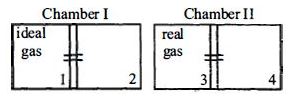
There are two identical chambers, completely thermally insulated from surroundings. Both chambers have a partition wall dividing the chambers in two compartments. Compartment $1$ is filled with an ideal gas and Compartment $3$ is filled with a real gas. Compartments $2$ and $4$ are vacuum . A small hole (orifice) is made in the partition walls and the gases are allowed to expand in vacuum

Statement $-1$ : No change in the temperature of the gas takes place when ideal gas expands in vacuum. However, the temperature of real gas goes down (cooling) when it expands in vacuum

Statement $-2$ : The internal energy of an ideal gas is only kinetic. The internal energy of a real gas is kinetic as well as potential
The impurity atoms with which pure silicon may be doped to make it a p-type semiconductor are those of:
  1. Phosphorus.
  2. Boron.
  3. Antimony.
  4. Aluminium.
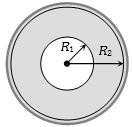
A sphere of mass $M$ and radius $R_2$ has a concentric cavity of radius $R_1$ as shown in figure. The force $F$ exerted by the sphere on a particle of mass $m$ located at a distance r from the centre of sphere varies as $(0 \le r \le \,\infty )$
The length $l$, breadth b and thickness t of a block of wood were measured with the help of a measuring scale. The results with permissible errors are $l=15.12 \pm 0.01\; cm , t =5.28 \pm 0.01 \;cm$ $b =10.15 \pm 0.01\; cm$. The percentage error in volume upto proper significant figures is
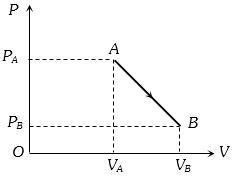
An ideal gas is taken from point $A$ to the point $B,$ as shown in the $P-V$ diagram, keeping the temperature constant. The work done in the process is
Let $\theta$ be the angle between vectors $\vec{A}$ and $\vec{B}$. Which of the following figures correctly represents the angle $\theta$ ?