MCQ
The value of $\sin ^{-1}\left(\frac{\sqrt{3}}{2}\right)+2 \cos ^{-1}\left(\frac{\sqrt{3}}{2}\right)$ :
  • A
    $\frac{\pi}{2}$
  • B
    $\frac{\pi}{3}$
  • $\frac{2 \pi}{3}$
  • D
    $\pi$

Answer

Correct option: C.
$\frac{2 \pi}{3}$
(C)
The range of principal value branch of $\sin ^{-1} x$ is $\left[\frac{-\pi}{2}, \frac{\pi}{2}\right]$ and the range of principal value branch of $\cos ^{-1} x$ is $[0, \pi]$.
$\therefore \sin ^{-1}\left(\frac{\sqrt{3}}{2}\right)=\frac{\pi}{3}$ and $\cos ^{-1}\left(\frac{\sqrt{3}}{2}\right)=\frac{\pi}{6}$
Hence, $\frac{\pi}{3}+2 \times \frac{\pi}{6}=\frac{\pi}{3}+\frac{\pi}{3}=\frac{2 \pi}{3}$
Hence correct option is (C)

Need a full question paper?

Generate a complete, print-ready paper with questions like this in minutes — across 16+ boards, with answer keys.
Start Generating Free

Similar questions

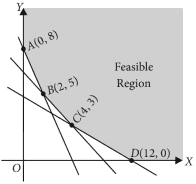
Feasible region for an L.P.P. is shown shaded in the following figure. Minimum of $Z=5 x+3 y$ occurs at the point point
Image
The function $\text{f(x)}=\frac{4-\text{x}^2}{4\text{x}-\text{x}^3}$
Column-$I$ Column-$II$
$(A)$ In $R ^2$, if the magnitude of the projection vector of the vector $\alpha \hat{i}+\beta \hat{j}$ on $\sqrt{3} \hat{i}+\hat{j}$ is $\sqrt{3}$ and if $\alpha=2+\sqrt{3} \beta$, then possible value(s) of $|\alpha|$ is (are) $(P)$ $1$
$(B)$ Let $a$ and $b$ be real numbers such that the function $f(x)=\left\{\begin{array}{cc}-3 a x^2-2, & x < 1 \\ b x+a^2, & x \geq 1\end{array}\right.$ is differentiable for all $x \in R$. Then possible value(s) of a is (are) $(Q)$ $2$
$(C)$ Let $\omega \neq 1$ be a complex cube root of unity. If $\left(3-3 \omega+2 \omega^2\right)^{4 n+3}$ $+\left(2+3 \omega-3 \omega^2\right)^{4 \omega+3}+\left(-3+2 \omega+3 \omega^2\right)^{4 \omega+3}=0$, then possible value(s) of $n$ is (are) $(R)$ $3$
$(D)$ Let the harmonic mean of two positive real numbers $a$ and $b$ be $4$. If $q$ is a positive real number such that $a, 5, q, b$ is an arithmetic progression, then the value$(s)$ of $|q-a|$ is (are) $(S)$ $4$
  $(T)$ $5$
If $f(x)=(2011+x)^n$, where $x$ is a real variable and $n$ is a positive integer, then the value of $f(0)+f^{\prime}(0)+\frac{f^{\prime \prime}(0)}{2 !}+\ldots+\frac{f^{\prime(n-1)}(0)}{(n-1) !}$ is
If by dropping a stone in a quiet lake a wave moves in circle at a speed of  $3.5 \,cm/sec,$ then the rate of increase of the enclosed circular region when the radius of the circular wave is  $10$  $cm,$ is ......... $c{m^2}/sec$. $\left( {\pi = {{22} \over 7}} \right)$
The function f(x) = x − [x], where [⋅] denotes the greatest integer function is:
Objective function of an LP problems is
The vector equation of the line joining the points $i-2j+k$ and  $-2j+3k$  is
The range of the function,

$\mathrm{f}(\mathrm{x})=\log _{\sqrt{5}}(3+\cos \left(\frac{3 \pi}{4}+\mathrm{x}\right)+\cos \left(\frac{\pi}{4}+\mathrm{x}\right)+\cos \left(\frac{\pi}{4}-\mathrm{x}\right)$

$-\cos \left(\frac{3 \pi}{4}-\mathrm{x}\right))$ is :

Can $\frac{1}{\sqrt{3}},\frac{2}{\sqrt{3}},\frac{-2}{\sqrt{3}}$ be the direction cosines of any directed line: