Question

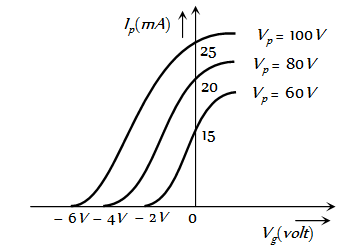
The variation of anode current in a triode corresponding to a change in grid potential at three different values of the plate potential is shown in the diagram. The mutual conductance of the triode is
(a) 2.5 m mho

(b) 5.0 m mho

(c) 7.5 m mho

(d) 10.0 m mho

Answer

(a) 2.5 m mho

Need a full question paper?

Generate a complete, print-ready paper with questions like this in minutes — across 16+ boards, with answer keys.

Start Generating Free

Similar questions

Two resistance wires on joining in parallel the resultant resistance is .  One of the wire breaks, the effective resistance is 2 ohms.  The resistance of the broken wire is

(a)  

(b) 2 ohm

(c)

(d) 3 ohm

A and B are two concentric circular conductors of centre O and carrying currents  and  as shown in the adjacent figure. If ratio of their radii is 1 : 2 and ratio of the flux densities at O due to A and B  is 1 : 3, then the value of   is

(a)   

(b)  

(c)  

(d)  

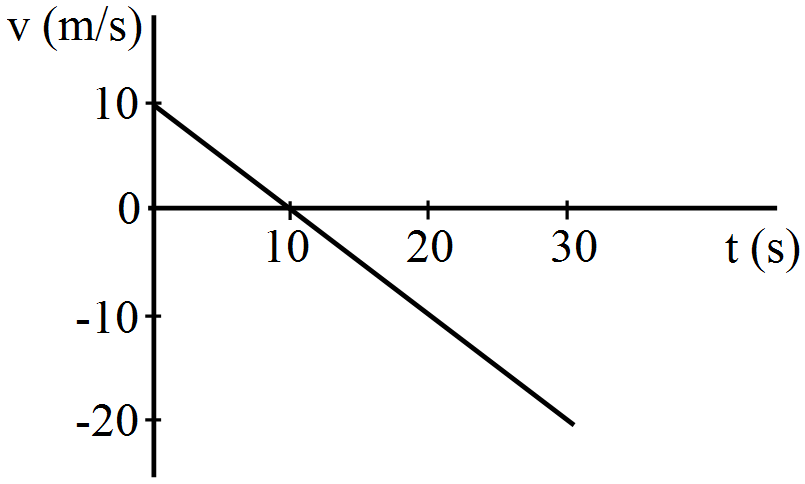
The velocity-time plot for a particle moving on a straight line is shown in the figure:

  1. The particle has a constant acceleration.
  2. The particle has never turned around.
  3. The particle has zero displacement.
  4. The average speed in the interval 0 to 10s is the same as the average speed in the interval 10s to 20s.
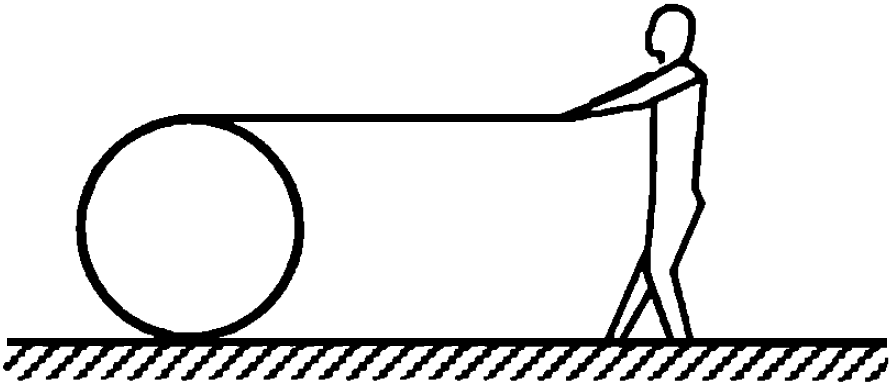
A string of negligible thickness is wrapped several times around a cylinder kept on a rough horizontal surface. A man standing at a distance 1 from the cylinder holds one end of the string and pulls the cylinder towards him. There is no slipping anywhere. The length of the string passed through the hand of the man while the cylinder reaches his hands is:
  1. l
  2. 2l
  3. 3l
  4. 4l

An object is at a distance of 0.5 m in front of a plane mirror. Distance between the object and image is

(a) 0.5 m                                            

(b) 1 m

(c) 0.25 m

(d) 1.5 m

A block of mass m slides down a smooth vertical circular track. During the motion, the block is in:
  1. Vertical equilibrium.
  2. Horizontal equilibrium.
  3. Radial equilibrium.
  4. None of these.

The focal length of a concave mirror is 50 cm. Where an object be placed so that its image is two times and inverted

(a) 75 cm

(b) 72 cm

(c) 63 cm

(d) 50 cm

When objects at different distances are seen by the eye, which of the following remain constant?
  1. The focal length of the eye-lens.
  2. The object-distance from the eye-lens.
  3. The radii of curvature of the eye-lens.
  4. The image-distance from the eye-lens.

Two radioactive materials  and  have decay constants 10λ  and λ respectively. If initially they have the same number of nuclei, then the ratio of the number of nuclei of   to that of   will be 1/e  after a time

(a) 1/(10 λ)

(b) 1/(11 λ)

(c) 11(10 λ)

(d) 1(9 λ)

The percentage of Sun's total energy which reaches the earth's surface is

(a) 10–7 %

(b) 10–6 %

(c) 10–3

(d) 10–2 %