MCQ
The vectors $2\,i + 3\,j - 4\,k$ and $a\,i + b\,j + c\,k$ are perpendicular, when
  • A
    $a = 2,\,\,b = 3,\,\,c = - 4$
  • $a = 4,\,\,b = 4,\,\,c = 5$
  • C
    $a = 4,\,\,b = 4,\,\,c = - \,5$
  • D
    None of these

Answer

Correct option: B.
$a = 4,\,\,b = 4,\,\,c = 5$
b
(b) To be perpendicular, $2a + 3b - 4c = 0$ and option $(b)$ satisfies this equation.

Need a full question paper?

Generate a complete, print-ready paper with questions like this in minutes — across 16+ boards, with answer keys.
Start Generating Free

Similar questions

$3$ cards are drawn one-by-one without replacement from a pack of well shuffled pack of $52$ cards, then probability that the first card is a heart, second a queen and third is a king is equal to
Let $I(x)=\int \frac{6}{\sin ^2 x(1-\cot x)^2} d x$. If $I(0)=3$, then $\mathrm{I}\left(\frac{\pi}{12}\right)$ is equal to :
If $\int\limits_e^x {t\,f(t)dt\, = \,\sin \,\,x - x\,\cos \,\,x - \frac{{{x^2}}}{2},} $ for all $x \in R - \{ 0 \} ,$ then the value of $f(\frac {\pi }{6})$ is
If R is a relation on the set A = {1, 2, 3} given by R = {(1, 1), (2, 2), (3, 3)}, then R is:
  1. Reflexive.
  2. Symmetric.
  3. Transitive.
  4. All the three options.
Choose the correct answers from the given four options:
The derivative of $\cos^{-1}(2\text{x}^2-1)$ w.r.t. $\cos^{-1}\text{x}$ is:
  1. $2$
  2. $\frac{-1}{2\sqrt{1-\text{x}^2}}$
  3. $\frac{2}{\text{x}}$
  4. $1-\text{x}^2$
The function $\text{f}(\text{x})=2\log(\text{x}-2)-\text{x}^2+4\text{x}+1$ increases on the interval:
  1. (1, 2)
  2. (2, 3)
  3. (1, 3)
  4. (2, 4)
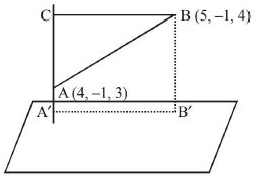
The length of the projection of the line segment joining the point  $\left( {5, - 1,4} \right)$ and $\left( {4, - 1,3} \right)$ on the plane $x + y + z = 7$ is :
A bag X contains 2 white and 3 black balls and another bag Y contains 4 white and 2 black balls. One bag is selected at random and a ball is drawn from it. Then, the probability chosen to be white is,
  1. $\frac{2}{15}$
  2. $\frac{7}{15}$
  3. $\frac{8}{15}$
  4. $\frac{14}{15}$
If $A=\left[\begin{array}{cc}2 & 3 \\ 5 & -2\end{array}\right]$, then adj $A$ is equal to
Let $\vec{a}$ be any vector such that $|\vec{a}|=a$. The value of $|\vec{a} \times \hat{i}|^2+|\vec{a} \times \hat{j}|^2+|\vec{a} \times \hat{k}|^2$ is :