Question
The velocity$-$displacement graph of a particle is shown in Fig.
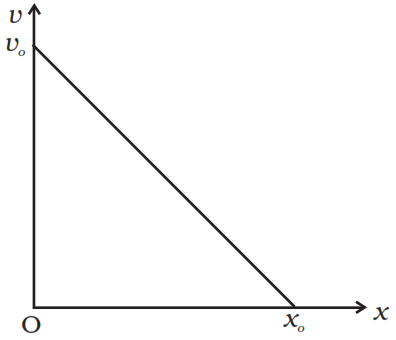
  1. Write the relation between $v$ and $x$.
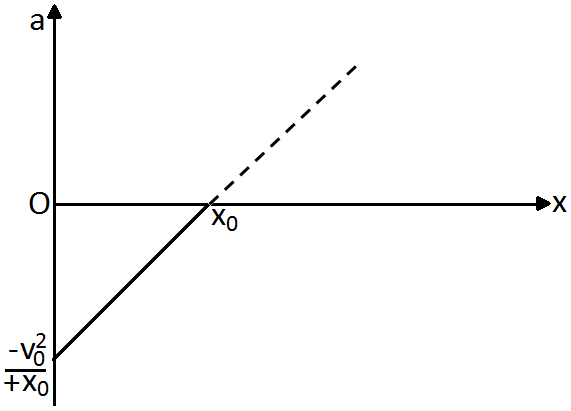
  2. Obtain the relation between acceleration and displacement and plot it.
Answer

In this problem, we will use equation of straight line graph $($linear equation$). y = mx + c$. In this equation, $m$ is the slope of the graph and $c$ is the interception on $y-$axis.

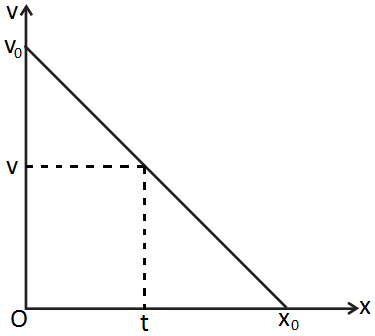
 Now according to the problem, initial velocity $= v_0$ Let the distance travelled in time $t = x_0$. For the graph $\tan\theta=\frac{\text{v}_0}{\text{x}_01}=\frac{\text{v}_0-\text{v}}{\text{x}}\ \ ...(\text{i})$ where, $v$ is velocity and $x$ is displacement at any instant of time $t.$ From Eq. $(i), \text{v}_0-\text{v}=\frac{\text{v}_0}{\text{x}_0}\text{x} $
$\Rightarrow\text{v}=\frac{-\text{v}_0}{\text{x}_0}\text{x}+\text{v}_0$ We know that Acceleration $\text{a}=\frac{\text{dv}}{\text{dt}}=\frac{-\text{v}_0}{\text{x}_0}\frac{\text{dx}}{\text{dt}}+0$
$\Rightarrow\text{a}=\frac{-\text{v}_0}{\text{x}_0}(\text{v})$ $=\frac{-\text{v}_0}{\text{x}_0}\Big(\frac{-\text{v}_0}{\text{x}_0}\text{x}+\text{v}_0\Big)=\frac{\text{v}_0^2}{\text{x}_0^2}\text{x}-\frac{\text{v}_0^2}{\text{x}_0}$ Graph of a versus $x$ is given below.
​​​​​​​

Need a full question paper?

Generate a complete, print-ready paper with questions like this in minutes — across 16+ boards, with answer keys.

Start Generating Free

Similar questions

Two masses $m_1$ and $m_2$ are connected by a spring of spring constant k and are placed on a frictionless horizontal surface. Initially the spring is stretched through a distance $x_0$ when the system is released from rest. Find the distance moved by the two masses before they again come to rest.
A square-shaped copper coil has edges of length 50cm and contains 50 turns. It is placed perpendicular to a 1.0T magnetic field. It is removed from the magnetic field in 0·25s and restored in its original place in the next 0·25s. Find the magnitude of the average emf induced in the loop during:
  1. Its removal.
  2. Its restoration.
  3. Its motion.
  1. Describe various modes of vibration in an open ends organ pipe.
  2. Show that the ratio of frequencies of different harmonics with the first harmonics in open pipe is $1 : 2 : 3$
  3. In an open organ pipe, the fundamental frequency is $30Hz$. If the organ pipe is closed at one end then what will be the fundamental frequency?
Two inclined frictionless tracks, one gradual and the other steep meet at A from where two stones are allowed to slide down from rest, one on each track. Will the stones reach the bottom at the same time? Will they reach there with the same speed? Explain. Given $\theta_1= 300,\theta_2= 600 ,$ and h = 10m, what are the speeds and times taken by the two stones?
A fighter plane is flying horizontally at an altitude of 1.5km with speed 720km/ h. At what angle of sight (w.r.t. horizontal) when the target is seen, should the pilot drop the bomb in order to attack the target?
A mass m is left free at a distance 3R from the surface of earth. On reaching the surface, what will be its velocity?
A gun kept on a straight horizontal road is used to hit a car travelling along the same road away from the gun with a uniform speed of 72km/ h. The car is at a distance of 500m from the gun when the gun is fired at an angle of 45° to the horizontal. Find,
  1. The distance of the car from the gun when the shell hits it.
  2. The speed of projection of the shell from the gun.
The nearest star to our solar system is $4.29$ light years away. How much is this distance in terms of parsecs? How much parallax would this star (named Alpha Centauri) show when viewed from two locations of the Earth six months apart in its orbit around the Sun?
Two particles A and B, each carrying a charge Q, are held fixed with a separation d between them. A particle C having mass m and charge q is kept at the middle point of the line AB.
  1. If it is displaced through a distance x perpendicular to AB, what would be the electric force experienced by it.
  2. Assuming x << d, show that this force is proportional to x.
  3. Under what conditions will the particle C execute simple harmonic motion if it is released after such a small displacement?
Find the time period of the oscillations if these conditions are satisfied.
For the wave described in Exercise 15.8, plot the displacement (y) versus (t) graphs for x = 0, 2 and 4cm. What are the shapes of these graphs? In which aspects does the oscillatory motion in travelling wave differ from one point to another: amplitude, frequency or phase?