MCQ
The velocity of a body can change:
  • A
    If its acceleration is zero.
  • If its acceleration is non-zero.
  • C
    Both $A \ and\  B$
  • D
    None of the above.

Answer

Correct option: B.
If its acceleration is non-zero.
$b.$  If its acceleration is non - zero.
Explanation:
Acceleration is defined as change of velocity in unit time. So if acceleration is zero, there is no change of velocity, the body is moving with a constant velocity.

Need a full question paper?

Generate a complete, print-ready paper with questions like this in minutes — across 16+ boards, with answer keys.
Start Generating Free

Similar questions

The electric field at the origin is along the positive x-axis. A small circle is drawn with the centre at the origin cutting the axes at points A, B, C and D having coordinates (a, 0), (0, a), (-a, 0), (0, -a) respectively. Out of the points on the periphery of the circle, the potential is minimum at.
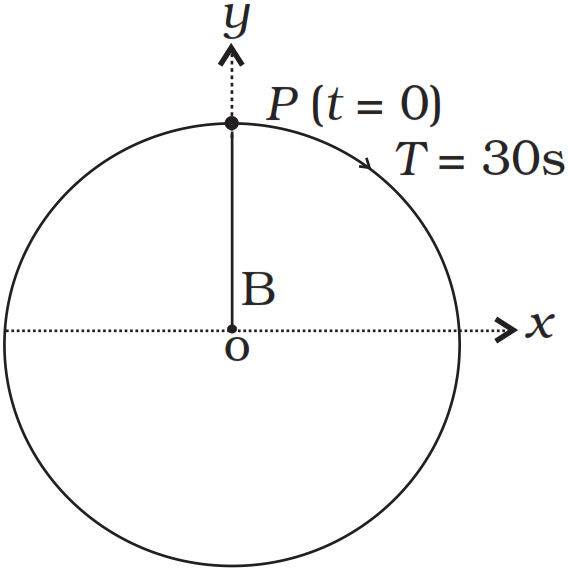
Figure shows the circular motion of a particle. The radius of the circle, the period, sense of revolution and the initial position are indicated on the figure. The simple harmonic motion of the $x-$projection of the radius vector of the rotating particle $P$ is:
A man of mass $80\ kg$ is standing inside a lift moving upward with a uniform velocity of $4\ m/s$ then the apparent weight of the person will be
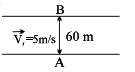
A man is crossing a river flowing with velocity of $5\,\, m/s$. He reaches a point directly across at a distance of $60\,\, m$ in $5 \,\,sec$. His velocity in still water should be ........ $m/s$
An ideal Carnot heat engine with an efficiency of $30\%$.It absorbs heat from a hot reservoir at  $727^o C$. The temperature of the cold reservoir is  .... $^oC$
Consider a satellite going round the earth in an orbit. Which of the following statements is wrong
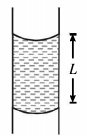
A vertical glass capillary tube of radius $r$ open at both ends contains some water (surface tension $T$ and density $\rho$ ). If $L$ be the length of the water column, then:
The ratio of Young's modulus of the material of two wires is $2 : 3.$ If the same stress is applied on both, then the ratio of elastic energy per unit volume will be
A ball is thrown vertically downward with a velocity of $20\; m / s$ from the top of a tower. It hits the ground after some time with a velocity of $80\, m / s$. The helght of the tower is $......m$ : $\left( g =10\, m / s ^{2}\right)$
A sinusoidal progressive wave is generated in a string. It’s equation is given by $y = (2\,\, mm) sin (2\pi x - 100 \pi t + \pi /3)$. The time when particle at $x = 4$ $m$ first passes through mean position, will be