The velocity of a particle executing SHM varies with displacement $( x )$ as $4 v ^2=50- x ^2$. The time period of oscillations is $\frac{x}{7} s$. The value of $x$ is $............$ $\left(\right.$ Take $\left.\pi=\frac{22}{7}\right)$
JEE MAIN 2023, Medium
Download our app for free and get started
$4 v ^2=50- x ^2$
$\Rightarrow \quad v =\frac{1}{2} \sqrt{50- x ^2}$
$\omega=\frac{1}{2}$
$T =\frac{2 \pi}{\omega}=4 \pi=\frac{88}{7}$
$x =88$

Download our appand get started for free
Experience the future of education. Simply download our apps or reach out to us for more information. Let's shape the future of learning together!No signup needed.*
Similar Questions
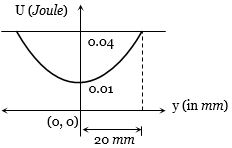
- 1View SolutionThe variation of potential energy of harmonic oscillator is as shown in figure. The spring constant is
- 2Two damped spring-mass oscillating systems have identical spring constants and decay times. However, system $A's$ mass $m_A$ is twice system $B's$ mass $m_B$ . How do their damping constants, $b$ , compare ?View Solution
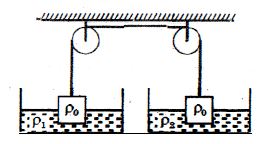
- 3Consider two identical cylinders [each of mass $m$ density $\rho _0$ horizontal cross-section area $s$] in equilibrium, partially submerged in two containers filled with liquids of densities $\rho_1$ and $\rho_2$ as shown in figure. Find the period of small oscillations of this system about its equilibrium. Neglect the changes in the level of liquids in the containers. Neglect mass of the strings. acceleration due to gravity is $g$ . ($v$ is volume of each block)View Solution
- 4View SolutionIdentify correct statement among the following
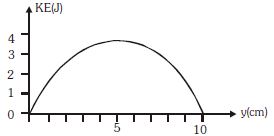
- 5A mass on a vertical spring begins its motion at rest at $y = 0\ cm$. It reaches a maximum height of $y = 10\ cm$. The two forces acting on the mass are gravity and the spring force. The graph of its kinetic energy ($KE$) versus position is given below. Net force on the mass varies with $y$ asView Solution
- 6The periodic time of a body executing simple harmonic motion is $3\, sec$. After how much interval from time $t = 0$, its displacement will be half of its amplitude ..... $\sec$View Solution
- 7A horizontal platform with an object placed on it is executing $S.H.M$. in the vertical direction. The amplitude of oscillation is $3.92 \times {10^{ - 3}}m$. What must be the least period of these oscillations, so that the object is not detached from the platformView Solution
- 8The angular velocity and the amplitude of a simple pendulum is $\omega $ and $a$ respectively. At a displacement $X$ from the mean position if its kinetic energy is $T$ and potential energy is $V$, then the ratio of $T$ to $V$ isView Solution
- 9View SolutionTo make the frequency double of a spring oscillator, we have to
- 10The position, velocity and acceleration of a particle executing simple harmonic motion are found to have magnitudes of $4 \mathrm{~m}, 2 \mathrm{~ms}^{-1}$ and $16 \mathrm{~ms}^{-2}$ at a certain instant. The amplitude of the motion is $\sqrt{\mathrm{x}} \mathrm{m}$ where $\mathrm{x}$ is. . . . . . .View Solution