Question
The wave front due to a source situated at infinity is:

Answer

  1. Planar
Explanation:
when you considered it a large distance and measuring justice Mall section of it then it can be considered to be plane wavefront source at Infinity example the one coming from sun to earth surface is considered to be plain VU friend from light diverging from a point source will be spherical.
So, the wave front due to a source situated at infinity is planar.

Need a full question paper?

Generate a complete, print-ready paper with questions like this in minutes — across 16+ boards, with answer keys.
Start Generating Free

Similar questions

Two bulbs of 100 W and 200 W working at 220 volt are joined in series with 220 volt supply. Total power consumed will be approximately. (a) 65 watt(b) 33 watt(c) 300 watt(d) 100 watt
       
An electromagnetic wave, going through vacuum is described by $\mathrm{E}=\mathrm{E}_0 \sin (\mathrm{kx}-\omega \mathrm{t})$. Which of the following is independent of wavelength
The device is based on the principle of mutual induction is:
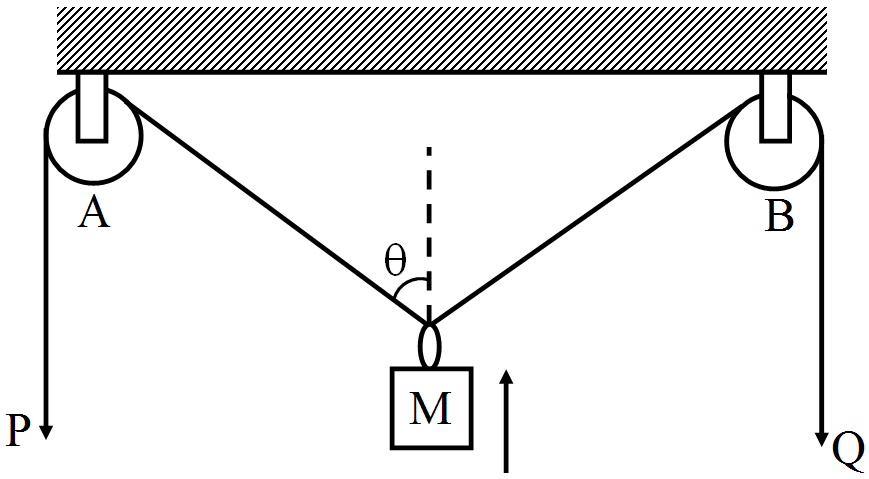
In the arrangement shown in figure, the ends P and Q of an inextensible string move downwards with uniform speed u. Pulleys A and B are fixed. The mass M moves upwards with a speed:
  1. $2\text{u}\cos\theta$
  2. $\frac{\text{u}}{\cos\theta}$
  3. $\frac{\text{2u}}{\cos\theta}$
  4. $\text{u}\cos\theta$
A conductor with a positive charge (a) Is always at +ve  potential(b) Is always at zero potential(c) Is always at negative potential(d) May be at +ve, zero or -ve potential
   
   
The observed wavelength of light coming from a distant galaxy is found to be increased by $0.5\%$ as compared with that coming from a terrestrial source. The galaxy is
A semiconductor dopped with a donor impurity is (a) P-type (b) N-type (c) NPN type (d) PNP type
       
Excitation energy of a hydrogen like ion in its first excitation state is 40.8 eV. Energy needed to remove the electron from the ion in ground state is(a) 54.4 eV(b) 13.6 eV(c) 40.8 eV(d) 27.2 eV
       
Which of the following when falls on a metal will emit photoelectrons?
Critical angle for light moving in from medium I to medium II is $\theta$. The speed of light in medium I is v. Then speed in medium II is :