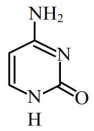
MCQ
The wave function $\psi_{n / m m}$ is a mathematical function whose value depends upon spherical polar coordinates $(r, \theta, \phi)$ of the electron and characterized by the quantum numbers $n, l$ and $m_l$. Here $r$ is distance from nucleus, $\theta$ is colatitude and $\phi$ is azimuth. In the mathematical functions given in the Table, $\mathrm{Z}$ is atomic number and $a_0$ is Bohr radius.

$column 1$ $column 2$ $column 3$
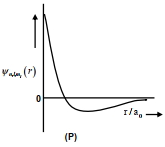
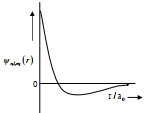
$(I)$ $1$s orbital $(i)$ $\psi_{n, l, m_l} \propto\left(\frac{Z}{a_0}\right)^{\frac{3}{2}} e^{-\left(\frac{Z r}{a_0}\right)}$ $image$
($II$) $2 \mathrm{~s}$ orbital $(ii)$ One radial node $(Q)$ Probability density at nucleus $\propto \frac{1}{a_0^3}$
$(III)$ $2 p_z$ orbital $(iii)$ $\psi_{n, l m_l} \propto\left(\frac{Z}{a_0}\right)^{\frac{5}{2}} r e^{-\left(\frac{Z r}{2 a_0}\right)} \cos \theta$ $(R)$ Probability density is maximum at nucleus
$(IV)$ $3 \mathrm{~d}_{\mathrm{z}}^2$ orbital $(iv)$ $x y$-plane is a nodal plane $(S)$ Energy needed to excite electron from $n=2$ state to $n=4$ state is $\frac{27}{32}$ times the energy needed to excite electron from $n=2$ state to $n=6$ state

($1$) For the given orbital in Column $1$, the only $CORRECT$ combination for any hydrogen-like species is

$[A] (IV) (iv) (R)$   $[B] (II) (ii) (P)$    $[C] (III) (iii) (P)$    $[D] (I) (ii) (S)$

($2$)  For $\mathrm{He}^{+}$ion, the only INCORRECT combination is

$[A] (II) (ii) (Q)$ $[B] (I) (i) (S)$ $[C] (I) (i) (R)$ $[D] (I) (iii) (R)$

($3$) For hydrogen atom, the only $CORRECT$ combination is

$[A] (I) (iv) (R)$   $[B] (I) (i) (P)$    $[C] (II) (i) (Q)$   $[D] (I) (i) (S)$

Give the answer quetion ($1$) ($2$) and ($3$)
  • $B,D,D$
  • B
    $B,D,$
  • C
    $B,A$
  • D
    $B,C$

Answer

Correct option: A.
$B,D,D$
a
 ($1$) $2 \mathrm{~s}$ orbital-One radial node $(\mathrm{n}-\ell-1)$

                         $(II)$                                $(ii)$

(image)

($2$) Is orbital can not have $\theta$ function (angular function). Therefore $\mathrm{D}$ is incorrect.

($3$) For hydrogen atom, the only CORRECT combination is

$[A] (I) (iv) (R)$ $[\mathrm{B}]$ $(I) (i) (P)$ $[C] (II) (i) (Q)$ $[D] (I) (i) (S)$

For H-atom:

1s orbital $-\Psi_{\text {II }} \propto\left(\frac{\mathrm{Z}}{\mathrm{a}_0}\right)^{3 / 2} \mathrm{e}^{-\left(\frac{Z}{\partial_0}\right)}, \mathrm{S}$

$\mathrm{E}_4-\mathrm{E}_2=-\frac{13.6}{16}-\left(-\frac{13.6}{4}\right)=\frac{3 \times 13.6}{16}$

$\mathrm{E}_6-\mathrm{E}_2=-\frac{13.6}{36}-\left(-\frac{13.6}{4}\right)=\frac{8 \times 13.6}{36}$

$\mathrm{E}_4-\mathrm{E}_2 \text { is } \frac{27}{32} \text { times of } \mathrm{E}_6-\mathrm{E}_2$

Need a full question paper?

Generate a complete, print-ready paper with questions like this in minutes — across 16+ boards, with answer keys.

Start Generating Free

Similar questions

Reactant A converts to product D through the given mechanism (with the net evolution of heat) :
$\mathrm{A} \rightarrow \mathrm{B}$ slow ; $\Delta \mathrm{H}=+\mathrm{ve}$
$\mathrm{B} \rightarrow \mathrm{C}$ fast; $\Delta \mathrm{H}=-\mathrm{ve}$
$\mathrm{C} \rightarrow \mathrm{D}$ fast; $\Delta \mathrm{H}=-\mathrm{ve}$
Which of the following represents the above reaction mechanism?
The internal energy change (in $J$ ) when $90\, g$ of water undergoes complete evaporation at $100^{\circ} C$ is........

(Given: $\Delta H _{\text {vap }}$ for water at $373\, K =41\, kJ / mol$, $\left. R =8.314\, JK ^{-1} mol ^{-1}\right)$

The reaction between $X$ and $Y$ is first order with respect to $X$ and zero order with respect to $Y$.

Experiment $\frac{[ X ]}{ mol \;L ^{-1}}$ $\frac{[ Y ]}{ mol\; L ^{-1}}$ $\frac{\text { Initial rate }}{ mol\; L ^{-1}\; min ^{-1}}$
$I$ $0.1$ $0.1$ $2 \times 10^{-3}$
$II$ $0.2$ $0.2$ $4 \times 10^{-3}$
$III$ $0.4$ $0.4$ $M \times 10^{-3}$
$IV$ $0.1$ $0.2$ $2 \times 10^{-3}$

Examine the data of table and calculate ratio of numerical value of $M$

The rate of the reaction, $2NO + Cl_2 \rightarrow 2NOCl$ is given by the rate equation rate $= k[NO]^2[Cl_2].$ The value of the rate constant can be increased by
Ozonolysis of  $2-$ methyl butene  $-2$  yields
Equal masses of $H_2, O_2$ and methane have been taken in a container of volume $V$ at temperature $27\, ^o C$ in identical conditions. The ratio of the volumes of gases $H_2 : O_2 :$ methane would be
Which of the following ions is coloured
In which pair of species the oxidation number of chlorine is same
The ionization energy of sodium in $\mathrm{kJ} \mathrm{mol}^{-1}$. If electromagnetic radiation of wavelength $242 \mathrm{~nm}$ is just sufficient to ionize sodium atom is____.
Match List-I with List-II.
 List - I List - II
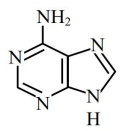
(A)Adenine(I)Image
(B)Cytosine(II)Image
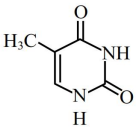
(C)Thymine(III)Image
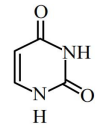
(D)Uracil(IV)Image
Choose the correct answer from the options given below :