MCQ
The wave function $\psi_{n / m m}$ is a mathematical function whose value depends upon spherical polar coordinates $(r, \theta, \phi)$ of the electron and characterized by the quantum numbers $n, l$ and $m_l$. Here $r$ is distance from nucleus, $\theta$ is colatitude and $\phi$ is azimuth. In the mathematical functions given in the Table, $\mathrm{Z}$ is atomic number and $a_0$ is Bohr radius.

$column 1$ $column 2$ $column 3$
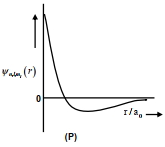
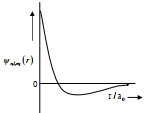
$(I)$ $1$s orbital $(i)$ $\psi_{n, l, m_l} \propto\left(\frac{Z}{a_0}\right)^{\frac{3}{2}} e^{-\left(\frac{Z r}{a_0}\right)}$ $image$
($II$) $2 \mathrm{~s}$ orbital $(ii)$ One radial node $(Q)$ Probability density at nucleus $\propto \frac{1}{a_0^3}$
$(III)$ $2 p_z$ orbital $(iii)$ $\psi_{n, l m_l} \propto\left(\frac{Z}{a_0}\right)^{\frac{5}{2}} r e^{-\left(\frac{Z r}{2 a_0}\right)} \cos \theta$ $(R)$ Probability density is maximum at nucleus
$(IV)$ $3 \mathrm{~d}_{\mathrm{z}}^2$ orbital $(iv)$ $x y$-plane is a nodal plane $(S)$ Energy needed to excite electron from $n=2$ state to $n=4$ state is $\frac{27}{32}$ times the energy needed to excite electron from $n=2$ state to $n=6$ state

($1$) For the given orbital in Column $1$, the only $CORRECT$ combination for any hydrogen-like species is

$[A] (IV) (iv) (R)$   $[B] (II) (ii) (P)$    $[C] (III) (iii) (P)$    $[D] (I) (ii) (S)$

($2$)  For $\mathrm{He}^{+}$ion, the only INCORRECT combination is

$[A] (II) (ii) (Q)$ $[B] (I) (i) (S)$ $[C] (I) (i) (R)$ $[D] (I) (iii) (R)$

($3$) For hydrogen atom, the only $CORRECT$ combination is

$[A] (I) (iv) (R)$   $[B] (I) (i) (P)$    $[C] (II) (i) (Q)$   $[D] (I) (i) (S)$

Give the answer quetion ($1$) ($2$) and ($3$)
  • $B,D,D$
  • B
    $B,D,$
  • C
    $B,A$
  • D
    $B,C$

Answer

Correct option: A.
$B,D,D$
a
 ($1$) $2 \mathrm{~s}$ orbital-One radial node $(\mathrm{n}-\ell-1)$

                         $(II)$                                $(ii)$

(image)

($2$) Is orbital can not have $\theta$ function (angular function). Therefore $\mathrm{D}$ is incorrect.

($3$) For hydrogen atom, the only CORRECT combination is

$[A] (I) (iv) (R)$ $[\mathrm{B}]$ $(I) (i) (P)$ $[C] (II) (i) (Q)$ $[D] (I) (i) (S)$

For H-atom:

1s orbital $-\Psi_{\text {II }} \propto\left(\frac{\mathrm{Z}}{\mathrm{a}_0}\right)^{3 / 2} \mathrm{e}^{-\left(\frac{Z}{\partial_0}\right)}, \mathrm{S}$

$\mathrm{E}_4-\mathrm{E}_2=-\frac{13.6}{16}-\left(-\frac{13.6}{4}\right)=\frac{3 \times 13.6}{16}$

$\mathrm{E}_6-\mathrm{E}_2=-\frac{13.6}{36}-\left(-\frac{13.6}{4}\right)=\frac{8 \times 13.6}{36}$

$\mathrm{E}_4-\mathrm{E}_2 \text { is } \frac{27}{32} \text { times of } \mathrm{E}_6-\mathrm{E}_2$

Need a full question paper?

Generate a complete, print-ready paper with questions like this in minutes — across 16+ boards, with answer keys.

Start Generating Free

Similar questions

The boiling point of benzene is $353.23\,\, K$. When $1.80\,gm$ of a nonvolatile solute was dissolved in $90\,gm$ of benzene, the boiling point is raised to $354.11\,K$. the molar mass of the solute is ........ $g\,mo{l^{ - 1}}$ . $[{K_b}$ for benzene $= 2.53 \,K\,mol^{-1}$]
White phosphorus contains
Consider the given reaction, Identify $^{\prime} X^{\prime}$ and $^{\prime}Y^{\prime}$
Given below are two statements: one is labelled as Assertion $(A)$ and the other is labelled as Reason $(R)$.

Assertion $(A)$ : $\mathrm{NH}_3$ and $\mathrm{NF}_3$ molecule have pyramidal shape with a lone pair of electrons on nitrogen atom. The resultant dipole moment of $\mathrm{NH}_3$ is greater than that of $\mathrm{NF}_3$.

Reason $(R)$ : In $\mathrm{NH}_3$, the orbital dipole due to lone pair is in the same direction as the resultant dipole moment of the $\mathrm{N}-\mathrm{H}$ bonds. $\mathrm{F}$ is the most electronegative element.

In the light of the above statements, choose the correct answer from the options given below:

Match complex ion (in List $I$) with number of unpaired electrons (in List $II$)

  List-$I$   List-$II$
$A$ $[Fe(H_2O)_6]^{2+}$ $P$ $0$
$B$ $[Fe(H_2O)_6]^{3+}$ $Q$ $1$
$C$ $[Fe(CN)_6]^{4-}$ $R$ $2$
$D$ $[Fe(CN)_6]^{3-}$ $S$ $4$
$E$ $[Ni(H_2O)_4]^{2+}$ $T$ $5$

$A$   $||$   $B$  $||$   $C$  $||$   $D$   $||$  $E$

If the activation energy of a reaction is $80.9 \,kJ \,mol^{-1},$ the fraction of molecules at $700 \,K$, having enough energy to react to form products is $e ^{-x}$. The value of $x$ is ....... .
(Rounded off to the nearest integer) $\left[\right.$ Use $\left. R =8.31 \,J \,K ^{-1} \,mol ^{-1}\right]$
$S{N^1}$ reaction is faster in
For the reaction ${H_2}\left( {1\,bar} \right) + 2AgC{l_{\left( s \right)}} \rightleftharpoons $$ 2A{g_{\left( s \right)}} + 2{H^ + }\left( {0.1\,M} \right) + 2C{l^ - }\left( {0.1\,M} \right)$ $\Delta {G^o} =  - 48,250\,J$ at ${25\,^o}C$. The standard emf of cell in which the given reaction takes place is ................. $\mathrm{V}$
Oxidation state of $Fe$  in ${K_3}[Fe{(CN)_6}]$
  Column $I$   Column $II$
$(A)$ Kohlrausch law can calculate $(P)$ $\frac{{\Lambda _m^c}}{{\Lambda _m^o}}$
$(B)$ Molar conductance ${\Lambda _m}$ $(Q)$ $\frac{1}{R} \times \frac{l}{A}$
$(C)$ Specific conductance Kappa $\to (k)$ $(R)$ $\Lambda _m^o\,of\,c{a_3}{(P{O_4})_2}$
$(D)$ Degree of ionization of weak electrolyte $(S)$ $\frac{{k \times 1000}}{M}$

Which of the following option show correct matches