MCQ
The wave function $\psi_{n / m m}$ is a mathematical function whose value depends upon spherical polar coordinates $(r, \theta, \phi)$ of the electron and characterized by the quantum numbers $n, l$ and $m_l$. Here $r$ is distance from nucleus, $\theta$ is colatitude and $\phi$ is azimuth. In the mathematical functions given in the Table, $\mathrm{Z}$ is atomic number and $a_0$ is Bohr radius.

$column 1$ $column 2$ $column 3$
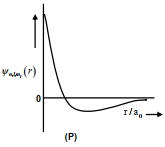
$(I)$ $1$s orbital $(i)$ $\psi_{n, l, m_l} \propto\left(\frac{Z}{a_0}\right)^{\frac{3}{2}} e^{-\left(\frac{Z r}{a_0}\right)}$ $image$
($II$) $2 \mathrm{~s}$ orbital $(ii)$ One radial node $(Q)$ Probability density at nucleus $\propto \frac{1}{a_0^3}$
$(III)$ $2 p_z$ orbital $(iii)$ $\psi_{n, l m_l} \propto\left(\frac{Z}{a_0}\right)^{\frac{5}{2}} r e^{-\left(\frac{Z r}{2 a_0}\right)} \cos \theta$ $(R)$ Probability density is maximum at nucleus
$(IV)$ $3 \mathrm{~d}_{\mathrm{z}}^2$ orbital $(iv)$ $x y$-plane is a nodal plane $(S)$ Energy needed to excite electron from $n=2$ state to $n=4$ state is $\frac{27}{32}$ times the energy needed to excite electron from $n=2$ state to $n=6$ state

($1$) For the given orbital in Column $1$, the only $CORRECT$ combination for any hydrogen-like species is

$[A] (IV) (iv) (R)$   $[B] (II) (ii) (P)$    $[C] (III) (iii) (P)$    $[D] (I) (ii) (S)$

($2$)  For $\mathrm{He}^{+}$ion, the only INCORRECT combination is

$[A] (II) (ii) (Q)$ $[B] (I) (i) (S)$ $[C] (I) (i) (R)$ $[D] (I) (iii) (R)$

($3$) For hydrogen atom, the only $CORRECT$ combination is

$[A] (I) (iv) (R)$   $[B] (I) (i) (P)$    $[C] (II) (i) (Q)$   $[D] (I) (i) (S)$

Give the answer quetion ($1$) ($2$) and ($3$)
  • $B,D,D$
  • B
    $B,D,$
  • C
    $B,A$
  • D
    $B,C$

Answer

Correct option: A.
$B,D,D$
a
 ($1$) $2 \mathrm{~s}$ orbital-One radial node $(\mathrm{n}-\ell-1)$

                         $(II)$                                $(ii)$

(image)

($2$) Is orbital can not have $\theta$ function (angular function). Therefore $\mathrm{D}$ is incorrect.

($3$) For hydrogen atom, the only CORRECT combination is

$[A] (I) (iv) (R)$ $[\mathrm{B}]$ $(I) (i) (P)$ $[C] (II) (i) (Q)$ $[D] (I) (i) (S)$

For H-atom:

1s orbital $-\Psi_{\text {II }} \propto\left(\frac{\mathrm{Z}}{\mathrm{a}_0}\right)^{3 / 2} \mathrm{e}^{-\left(\frac{Z}{\partial_0}\right)}, \mathrm{S}$

$\mathrm{E}_4-\mathrm{E}_2=-\frac{13.6}{16}-\left(-\frac{13.6}{4}\right)=\frac{3 \times 13.6}{16}$

$\mathrm{E}_6-\mathrm{E}_2=-\frac{13.6}{36}-\left(-\frac{13.6}{4}\right)=\frac{8 \times 13.6}{36}$

$\mathrm{E}_4-\mathrm{E}_2 \text { is } \frac{27}{32} \text { times of } \mathrm{E}_6-\mathrm{E}_2$

Need a full question paper?

Generate a complete, print-ready paper with questions like this in minutes — across 16+ boards, with answer keys.

Start Generating Free

Similar questions

The state of gas can be described by quoting the relationship between,
If $(i)$ $C + {O_2} \to C{O_2}$, $(ii)$ $C + 1/2{O_2} \to CO$, $(iii)$ $CO + 1/2{O_2} \to C{O_2}$, the heats of reaction are $Q,\, - 12,\, - 10$ respectively. Then $Q = $
In a constant volume calorimeter, $3.5 \mathrm{~g}$ of a gas with molecular weight $28$ was burnt in excess oxygen at $298.0 \mathrm{~K}$. The temperature of the calorimeter was found to increase from $298.0 \mathrm{~K}$ to $298.45 \mathrm{~K}$ due to the combustion process. Given that the heat capacity of the calorimeter is $2.5 \mathrm{~kJ} \mathrm{~K}^{-1}$, the numerical value for the enthalpy of combustion of the gas in $\mathrm{kJ} \mathrm{mol}^{-1}$ is
Which of the following is responsible for cleansing action of Borax
What will be the $IUPAC$ name of the given compound

$\begin{array}{*{20}{c}}
  {\,\,\,\,\,\,\,\,\,\,\,\,\,\,\,\,\,\,\,\,\,\,\,\,\,\,\,\,\,\,\,\,\,C{H_3}\,\,\,\,\,\,\,\,\,\,\,\,\,\,\,\,\,\,\,\,C{H_2} - C{H_3}} \\ 
  {\,\,\,\,\,\,\,\,\,\,\,\,\,\,\,\,|\,\,\,\,\,\,\,\,\,\,\,\,\,\,\,\,\,\,\,\,\,\,\,\,\,\,\,\,\,\,\,\,|} \\ 
  {C{H_3} - CH - CH - C{H_2} - CH - C{H_3}} \\ 
  {|\,\,\,\,\,\,\,\,\,\,\,\,\,\,\,\,\,\,\,\,\,\,\,\,\,\,\,\,\,\,\,\,\,\,\,\,\,\,\,\,\,\,\,\,\,\,\,\,} \\ 
  {C{H_2} - C{H_{3\,\,\,\,}}\,\,\,\,\,\,\,\,\,\,\,\,\,\,\,\,\,\,\,\,\,\,\,\,} 
\end{array}$

Bauxite containing impurities of iron oxide is purified by
Benzene reacts with $n-$ propyl chloride in the presence of anhydrous $AlCl_3$ to give predominantly :
Which one of the following pairs of species have the same bond order ?
If moving proton, dutron and alpha particle have same De-Broglie wave length then which is correct order of their kinetic energy
Which has zero dipole moment ?