Question
The wavelength of light in a medium is $\lambda=\frac{\lambda_0}{\mu},$ where $\lambda$ is the wavelength in vacuum. A beam of red light $(\lambda_0=720\text{nm})$ enters into water. The wavelength in water is $\lambda=\frac{\lambda_0}{\mu}=540\text{nm}.$ To a person under water does this light appear green?
Answer

Colour of light will depend only on the frequency of light and not on the wavelength of the light. So, light will appear red to an observer under water.

Need a full question paper?

Generate a complete, print-ready paper with questions like this in minutes — across 16+ boards, with answer keys.

Start Generating Free

Similar questions

A copper wire of diameter 1.6 mm carries 20A. Find the maximum magnitude of the magnetic field $\overrightarrow{\text{B}}$ due to this current.
A boy puts a heavy box of mass M on his head and jumps down from the top of a multistoried building to the ground. How much is the force exerted by the box on his head during his free fall? Does the force greatly increase during the period he balances himself after striking the ground?
The distance between the cathode (filament) and the target in an X-ray tube is 1.5m. If the cutoff wavelength is 30pm, find the electric field between the cathode and the target.
Suggest a way to measure:
  1. The thickness of a sheet of paper.
  2. The distance between the sun and the moon.
Derive the equation of intensity of resultant wave generated due to super postion (or interference) of waves generated from two coherent sources.
An oil drop of $12$ excess electrons is held stationary under a constant electric field of $2.55 \times 10^4 NC^{-1}$ in Millikan’s oil drop experiment. The density of the oil is $1.26 g \ cm^{-3}$. Estimate the radius of the drop. $(g = 9.81\  m\ s^{-2}; e = 1.60 \times 10^{-19} C).$
From what it can be said that the electric charge on any object is always an integral multiple of 'e' ?
Explain simple microscope. Obtain the equation of magnification for the image formed at near point.
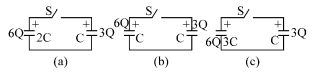
Three circuits, each consisting of a switch ' S ' and two capacitors, are initially charged as shown in the figure. In which circuit, when the switch is closed, the charge on the given capacitor will (i) increase, (ii) decrease and (iii) remain unchanged? Give reason.
Image
If we cover the lower half of the reflecting surface of a concave mirror with some opaque (nonreflective) material, then what effect will this have on the image formed by the mirror of an object situated in front of the mirror?