MCQ
The work done by all the forces (external and internal) on a system equals the change in:
  • Total energy.
  • B
    Kinetic energy.
  • C
    Potential energy.
  • D
    None of these.

Answer

Correct option: A.
Total energy.
The work done by all the forces (external and internal) on a system is equal to the change in the total energy.

Need a full question paper?

Generate a complete, print-ready paper with questions like this in minutes — across 16+ boards, with answer keys.

Start Generating Free

Similar questions

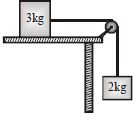
Consider a body of mass $3\,kg$ at rest on a smooth horizontal table. This body is  connected by a light string, which passes over a smooth pulley at the edge of the  table, to another body of mass $2\, kg$ hanging freely. This $2\, kg$ mass is released  from rest. Now consider the following statements :-

$(A)$ The masses remains at rest

$(B)$ The $3\,kg$ mass moves uniformly while $2\, kg$ mass moves with acceleration $\frac{2}{5}\, g \,m/s^2$

$(C)$ Both bodies move with acceleration $\frac{2}{5} \,g \,m/s^2$

$(D)$ The tension in the string near the first body is more than that near the second  body 

$(E)$ The tension in the string is $\frac{6g}{5}\, N $

Then the correct statements are
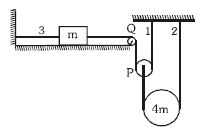
Shown in the diagram is a system of two bodies, a block of mass $m$ and a disc of mass $4\ m$ , held in equilibrium. If the string $3$ is burnt, find the acceleration of the disc. Neglect the masses of the pulleys $P$ and $Q$ . The co-efficient of friction between the block and horizontal surface is $0.5$ and friction between disc and string is zero ........ $m/s^2$
A rocket has an initial mass of $20 \times {10^3}\,kg$. If it is to blast off with an initial acceleration of $4\,m{s^{ - 2}}$, the initial thrust needed is  $(g = 10\,m{s^{ - 2}})$
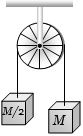
Two masses $M$ and $M/2$ are joint together by means of a light inextensible string passes over a frictionless pulley as shown in figure. When bigger mass is released the small one will ascend with an acceleration of
An object thrown vertically up from the ground passes the height $5 m$ twice in an interval of $10 s$. time of flight is ........ $s$
If force $(F),$ velocity $(V)$ and time $(T)$ are taken as fundamental units, then the dimensions of mass are 
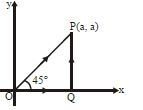
A particle is moved from $(0, 0)$  to $(a, a)$  under a force $F = (3\hat i + 4\hat j)$ from two paths. Path $1$ is $OP$ and path $2$  is $OQP$ . Let $W_1$ and $W_2$ be the work done by this force in these two paths respectively. Then
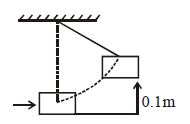
A bullet of mass $0.01\, kg$ and travelling at a speed of $500\, m/s$ strikes and passes horizontally through a block of mass $2\,kg$ which is suspended by string of string of length $5\,m$. The centre of gravity of the block is found to raise a vertical distance of $0.1\,m$. What is the speed of the bullet after it emerges from the block .......... $\mathrm{m}/ \mathrm{s}$ $[g = 9.8\,m/s^2]$ (time of passing of bullet is negligible)
Body $A$ of mass $4 \;\mathrm{m}$ moung with speed $u$ collides with another body $B$ of mass $2\; \mathrm{m}$, at rest. The collision is head on and elastic in nature. After the collision the fraction of energy lost by the colliding body $A$ is
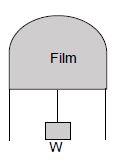
A thin liquid film formed between a $U-$ shaped wire and a light slider supports a weight of $1.5 \times 10^{-2}\ N$ (see figure). The length of the slider is $30\ cm$ and its weight are negligible. The surface tension of the liquid film is