Question
The work done by all the forces (external and internal) on a system equals the change in:
  1. Total energy.
  2. Kinetic energy.
  3. Potential energy.
  4. None of these.

Answer

  1. Total energy.

Explanation:

The work done by all the forces (external and internal) on a system is equal to the change in the total energy.

Need a full question paper?

Generate a complete, print-ready paper with questions like this in minutes — across 16+ boards, with answer keys.
Start Generating Free

Similar questions

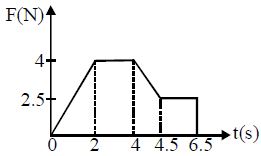
A body old $2\ kg$ has an initial speed $5\ ms^{-1}$ . A force acts on it for some time in the direction of motion. The force time graph is shown in figure. The final speed of the body .......... $ms^{-1}$
A diatomic gas $(\gamma=1.4)$ does $100 \mathrm{~J}$ of work in an isobaric expansion. The heat given to the gas is :
A ground to ground projectile is at point $A$ at $t=\frac{T}{3}$, is at point $B$ at $t=\frac{5 T}{6}$ and reaches the ground at $t=T$. The difference in heights between points $A$ and $B$ is
The total energy of particle performing S.H.M. is depends on:
A container of fixed volume has a mixture of one mole of hydrogen and one mole of helium in equilibrium at temperature $T$. Assuming the gases are ideal, the correct statement$(s)$ is(are)

$(A)$ The average energy per mole of the gas mixture is $2RT$.

$(B)$ The ratio of speed of sound in the gas mixture to that in helium gas is $\sqrt{6 / 5}$.

$(C)$ The ratio of the rms speed of helium atoms to that of hydrogen molecules is $1 / 2$.

$(D)$ The ratio of the rms speed of helium atoms to that of hydrogen molecules is $1 / \sqrt{2}$.
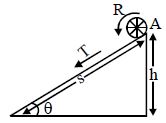
Suppose a body of mass $M$ and radius $R$ is allowed to roll on an inclined plane without slipping from its topmost point $A$. The velocity acquired by the body, as it reaches the bottom of the inclined plane, is given by $\beta  = 1 + \frac{I}{{M{R^2}}}$
The dimensions of pressure is equal to
The ratio of specific heat of a mixture of one mole of helium and one mole of hydrogen gas will be
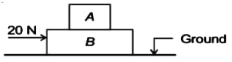
Blocks shown in figure moves with constant velocity $10 \,m / s$ towards right. All surfaces in contact are rough. The friction force applied by ground on block $B$ is ........ $N$
A point $P$ consider at contact point of a wheel on ground which rolls on ground without slipping then value of displacement of point $P$ when wheel completes half of rotation (If radius of wheel is $1 m$ )