Question
The work done by the external forces on a system equals the change in:
- Total energy.
- Kinetic energy.
- Potential energy.
- None of these.
Explanation:
When work is done by an external forces on a system, the total energy of the system will change.
Generate a complete, print-ready paper with questions like this in minutes — across 16+ boards, with answer keys.
In the nuclear reaction  , the values of A and Z are
|
(a) A = 234, Z = 94 |
(b) A = 234, Z = 90 |
(c) A = 238, Z = 94 |
(d) A = 238, Z = 90 |
A charge of magnitude 3e and mass 2m is moving in an electric field  . The acceleration imparted to the charge is
|
(a) 2Ee/3m |
(b) 3Ee/2m |
(c) 2m/3Ee |
(d) 3m/2Ee |
The charge of an electron is 1.6 × 10⁻¹⁹ C. How many electrons strike the screen of a cathode ray tube each second when the beam current is 16 mA
|
(a) 1017 |
(b) 1019 |
(c) 10–19 |
(d) 10–17 |
An electric wire of length ‘I’ and area of cross-section a has a resistance R ohms. Another wire of the same material having same length and area of cross-section 4a has a resistance of
|
(a) 4R |
(b) R/4 |
(c) R/16 |
(d) 16R |
Between the plates of a parallel plate condenser, a plate of thickness  and dielectric constant
  is placed. In the rest of the space, there is another plate of thickness
  and dielectric constant
  . The potential difference across the condenser will be
|
(a) |
(b) |
(c) |
(d) |
The size of an atom is of the order of
|
(a) |
(b) |
(c) |
(d) |
An uncharged capacitor is connected to a battery. On charging the capacitor
|
(a) All the energy supplied is stored in the capacitor |
|
(b) Half the energy supplied is stored in the capacitor |
|
(c) The energy stored depends upon the capacity of the capacitor only |
|
(d) The energy stored depends upon the time for which the capacitor is charged |
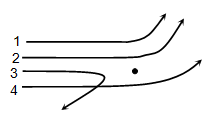
The diagram shows the path of four a-particles of the same energy being scattered by the nucleus of an atom simultaneously. Which of these are/is not physically possible
|
(a) 3 and 4 |
(b) 2 and 3 |
(c) 1 and 4 |
(d) 4 only |
Which of the following particle has similar mass to electron
|
(a) Proton |
(b) Neutron |
(c) Positron |
(d) Neutrino |