MCQ
The work done by the external forces on a system equals the change in:
  • Total energy.
  • B
    Kinetic energy.
  • C
    Potential energy.
  • D
    None of these.

Answer

Correct option: A.
Total energy.
When work is done by an external forces on a system, the total energy of the system will change.

Need a full question paper?

Generate a complete, print-ready paper with questions like this in minutes — across 16+ boards, with answer keys.
Start Generating Free

Similar questions

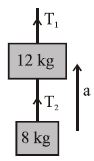
A body of mass $8\,kg$ is hanging from another body of mass $12\,kg$. The combination is being pulled by a string with an acceleration of $2.2\,ms^{-2}$. The tension $T_1$ will be  ............ $N$
Two strings A and B, made of same material, are stretched by same tension. The radius of string A is double of the radius of B. A transverse wave travels on A with speed $\nu_\text{A}$ and on B with speed $\nu_\text{B}.$ The ratio $\frac{\nu_\text{A}}{\nu_\text{B}}$ is:
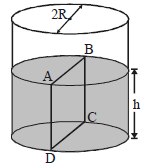
Water is filled up to a height $h$ in a beaker of radius $R$ as shown in the figure. The density of water is $\rho$, the surface tension of water is $T$ and the atmospheric pressure is $P_0$. Consider a vertical section $ABCD$ of the water column through a diameter of the beaker. The force on water on one side of this section by water on the other side of this section has magnitude
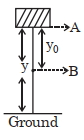
In the given figure, the block of mass $m$ is dropped from the point ' $A$ '. The expression for kinetic energy of block when it reaches point ' $B$ ' is ................
A very large block of ice of the size of a volleyball court and of uniform thickness of $8 \,m$ is floating on water. A person standing near its edge wishes to fetch a bucketful of water using a rope. The smallest length of rope required for this is about ............... $m$
Identify the correct statement 
A spherical planet has a mass $M_p$ and diameter $D_p$. A particle of mass $m$ falling freely near the surface of this planet will experience an acceleration due to gravity, equal to:
$A$ and $B$ are arguing about uniform acceleration. $A$ states that acceleration means "the longer you go." $B$ states that acceleration means "the further you go." Who is right?
In an adiabatic process where in pressure is increased by $\frac{2}{3}\% $ if $\frac{{{C_p}}}{{{C_v}}} = \frac{3}{2},$ then the volume decreases by about
The rms speed of oxygen molecules in a gas is v. If the temperature is doubled and the oxygen molecules dissociate into oxygen atoms, the rms speed will become: