MCQ
The work function of a metal is:
- AThe energy for the electron to enter into the metal
- BThe energy for producing X−ray
- CThe energy for the electron to come out from metal surface
- DNone of these
Explanation:
The work function of a metal is the energy for the electron to come out from metal surface.
Generate a complete, print-ready paper with questions like this in minutes — across 16+ boards, with answer keys.
The intensity distribution of X-rays from two coolidge tubes operated on different voltages V1 and V2 and using different target materials of atomic numbers Z1 and Z2 is shown in the figure. Which one of the following inequalities is true?
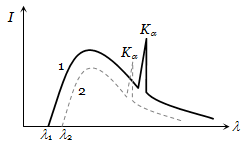
|
(a) V1 > V2, Z1 < Z2 |
(b) V1 > V2, Z1 > Z2 |
(c) V1 < V2, Z1 > Z2 |
(d) V1 = V2, Z1 < Z2 |
The equivalent resistance of the arrangement of resistances shown in adjoining figure between the points A and B is

|
(a) 6 ohm |
(b) 8 ohm |
(c) 16 ohm |
(d) 24 ohm |
The time required to pass the light through a glass slab of 2 mm thick is ( )
)
|
(a) |
(b) |
(c) |
(d) |
A 25 watt, 220 volt bulb and a 100 watt, 220 volt bulb are connected in series across a 220 volt lines. Which electric bulb will glow more brightly
|
(a) 25 watt bulb |
(b) 100 watt bulb |
|
(c) First 25 watt and then 100 watt |
(d) Both with same brightness |
A beam of light AO is incident on a glass slab (μ = 1.54) in a direction as shown in figure. The reflected ray OB is passed through a Nicol prism on viewing through a Nicole prism, we find on rotating the prism that

|
(a) The intensity is reduced down to zero and remains zero |
|
(b) The intensity reduces down some what and rises again |
|
(c) There is no change in intensity |
|
(d) The intensity gradually reduces to zero and then again increases |
A cell of negligible resistance and e.m.f. 2 volts is connected to series combination of 2, 3 and 5 ohm. The potential difference in volts between the terminals of 3 ohm resistance will be
|
(a) 0.6 |
(b) 2/3 |
(c) 3 |
(d) 6 |


