MCQ
The work function of a metal is:
  • A
    The energy for the electron to enter into the metal
  • B
    The energy for producing $X−$ray
  • The energy for the electron to come out from metal surface
  • D
    None of these

Answer

Correct option: C.
The energy for the electron to come out from metal surface

The work function of a metal is the energy for the electron to come out from metal surface.

Need a full question paper?

Generate a complete, print-ready paper with questions like this in minutes — across 16+ boards, with answer keys.
Start Generating Free

Similar questions

A long straight wire is carrying current $I_1$ in $+z$ direction. The $x-y$ plane contains a closed circular loop carrying current $I_2$ and not encircling the straight wire. The force on the loop will be:
What happens to the mass number and atomic number of an element when it emits $\gamma$-radiation?
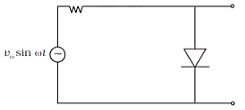
The output of the given circuit in Figure.
Image
Within a spherical charge distribution of charge density $\rho \left( r \right)$, $N$ equipotential surfaces of potential ${V_0},{V_0} + \Delta V,{V_0} + 2\Delta V,$$.....{V_0} + N\Delta V\left( {\Delta V > 0} \right),$ are drawn and have increasing radii $r_0, r_1, r_2,......r_N$, respectively. If the difference in the radii of the surfaces is constant for all values of $V_0$ and $\Delta V$ then
The energy released by the fission of a single uranium nucleus is $200 \,MeV$. The number of fissions of uranium nucleus per second required to produce $16\, MW$ of power is

 (Assume efficiency of the reactor is $50\%$)
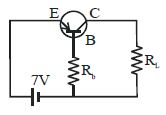
In the given transistor circuit, the base current is $35\,\mu A$. The value of $R_b$ is.......$k\Omega $
In general, metallic ropes are suspended on the carriers which take inflammable material. The reason is
Two spherical conductors $A$ and $B$ of radii $1\ mm$ and $2\  mm$ are separated by a distance of $5\ cm$ and are uniformly charged. If the spheres are connected by a conducting wire then in equilibrium condition, the ratio of the magnitude of the electric fields at the surfaces of spheres $A$ and $B$ is
The region of the atmosphere above troposphere is known as
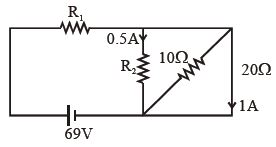
In the circuit shown in the given figure the resistance $R_1$ and $R_2$ are respectively