Question
The work function of caesium is $2.14 eV$. Find (a) the threshold frequency for caesium, and (b) the wavelength of the incident light if the photocurrent is brought to zero by a stopping potential of $0.60 V$.

Answer

(a) For the cut-off or threshold frequency, the energy $h v_0$ of the incident radiation must be equal to work function $\phi_0$, so that
$
\begin{aligned}
v_0 & =\frac{\phi_0}{h}=\frac{2.14 eV }{6.63 \times 10^{-34} J s } \\
& =\frac{2.14 \times 1.6 \times 10^{-19} J }{6.63 \times 10^{-34} J s }=5.16 \times 10^{14} Hz
\end{aligned}
$
Thus, for frequencies less than this threshold frequency, no photoelectrons are ejected.

(b) Photocurrent reduces to zero, when maximum kinetic energy of the emitted photoelectrons equals the potential energy $e V_0$ by the retarding potential $V_0$. Einstein's Photoelectric equation is
$
\begin{aligned}
e V_0 & =h v-\phi_0=\frac{h c}{\lambda}-\phi_0 \\
\text { or, } \quad \lambda & =h c /\left(e V_0+\phi_0\right) \\
& =\frac{\left(6.63 \times 10^{-34} J s \right) \times\left(3 \times 10^8 m / s \right)}{(0.60 eV +2.14 eV )} \\
& =\frac{19.89 \times 10^{-26} J m }{(2.74 eV )} \\
\lambda & =\frac{19.89 \times 10^{-26} J m }{2.74 \times 1.6 \times 10^{-19} J }=454 nm
\end{aligned}
$

Need a full question paper?

Generate a complete, print-ready paper with questions like this in minutes — across 16+ boards, with answer keys.
Start Generating Free

Similar questions

When a charged comb is brought near a small piece of paper, it attracts the piece. Does the paper become charged when the comb is brought near it?
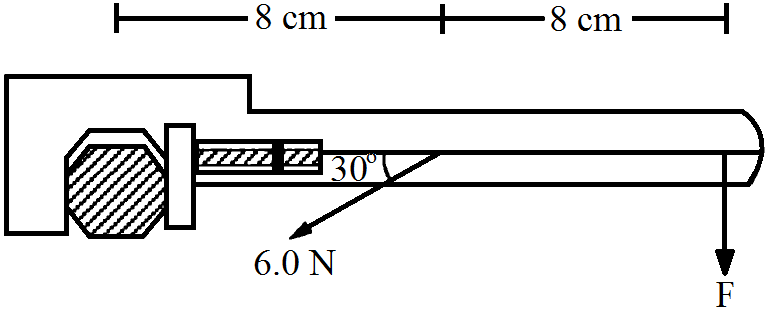
When a force of 6.0N is exerted at 30° to a wrench at a distance of 8cm from the nut, it is just able to loosen the nut. What force F would be sufficient to loosen it if it acts perpendicularly to the wrench at 16cm from the nut?
State two important properties of photon which are used to write Einstein's photoelectric equation. Define (i) Stopping potential and (ii) Threshold frequency, using Einstein's equation and drawing necessary plot between relevant quantities.
Suppose A and B in the previous problem change their positions in such a way that the line joining them becomes perpendicular to the direction of wind while maintaining the separation x. What will be the time lag B finds between seeing and hearing the drum beating by A?
  1. Draw the equipotential surfaces corresponding to a uniform electric field in the z-direction.
  2. Derive an expression for the electric potential at any point along the axial line of an electric dipole.
  1. Describe the working of photodiode by drawing the circuit diagram.
  2. Draw the characteristics of a photodiode for different illumination intensities.
  3. Why is photodiode operated in reverse bias even though the reverse bias current is much weaker than the current in forward bias?
A particle having a charge of $2.0 \times 10^{-4}C$ is placed directly below and at a separation of $10\ cm$ from the bob of a simple pendulum at rest. The mass of the bob is $100g.$ What charge should the bob be given so that the string becomes loose?
Area of a parallel plate capacitor is A and distance between them is $d$. It is charged with a constant current of I. An element of area $\frac{A}{2}$ is kept in the middle of the plates, parallel to the plates. What is the current flowing through this area?
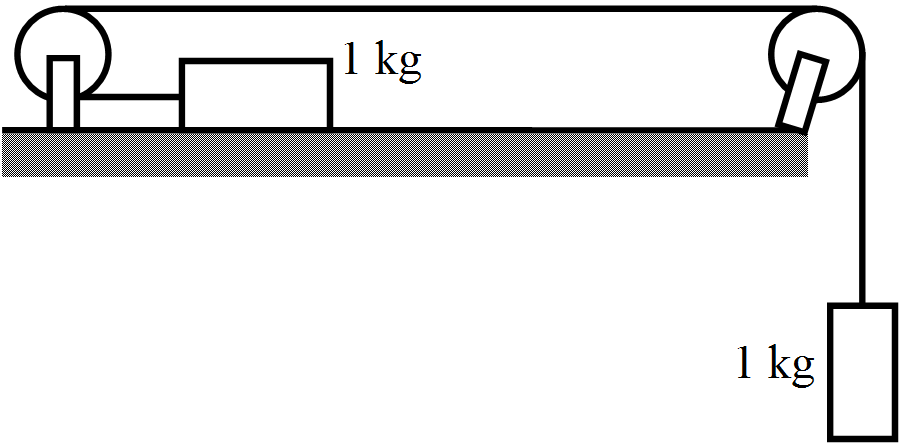
Calculate the tension in the string shown in figure. The pulley and the string are light and all surfaces are frictionless. Take $g = 10m/s^2.$
The moment of inertia of a uniform rod of mass $0.50\ kg$ and length $1m$ is $0.10\ \text{ kg-m}^2$ about a line perpendicular to the rod. Find the distance of this line from the middle point of the rod.