MCQ
The work function of cesium metal is $2eV$. It means that
  • The energy necessary to emit electrons from metal surface is $2eV$
  • B
    The energy of electrons emitted from metallic surface is $2eV$
  • C
    The value of photoelectric current is $2eV$
  • D
    The value of threshold frequency is $2eV$
Answer

Correct option: A.
The energy necessary to emit electrons from metal surface is $2eV$

By definition the work function is the minimum energy $($in electron volts$)$ needed to remove an electron from a solid to a point immediately outside the solid surface $($or energy needed to move an electron from the Fermi level into vacuum$).$
Hence, if the work function of cesium metal is $2ev$, it means that the energy necessary to emit electrons from metal surface is $2eV.$

Need a full question paper?

Generate a complete, print-ready paper with questions like this in minutes — across 16+ boards, with answer keys.

Start Generating Free

Similar questions

A charged particle of charge $Q $ is held fixed and another charged particle of mass $m$ and charge $q$ (of the same sign) is released from a distance $r.$ The impulse of the force exerted by the external agent on the fixed charge by the time distance between $Q$ and $q$ becomes $2r$ is
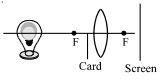
$A$ opaque card is held over the lower half of a converging lens as shown in figure. Which picture is best shows the image that appears on the screen.
The electric potential at the surface of an atomic nucleus $(Z = 50)$ of radius $9.0×{10^{ - 13}}\, cm$ is
Out of the following, which colour's wavelength is more than the wavelength of yellow colour?
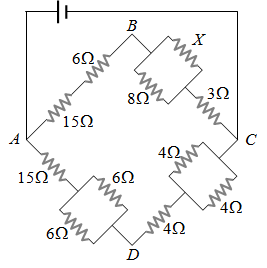
In the figure given the value of X resistance will be, when the p.d. between B and D is zero
A $25\, m$ long antenna is mounted on an antenna tower. The height of the antenna tower is $75\, m$. The wavelength (in meter) of the signal transmitted by this antenna would be
There is an equiconvex glass lens with radius of each face as $R$ and $_a{\mu _g} = 3/2$ and $_a{\mu _w} = 4/3$. If there is water in object space and air in image space, then the focal length is
Image of an object approaching a convex mirror of radius of curvature $20\  m$ along its optical axis is observed to move from $\frac{{25}}{3}\ m$ to $\frac{{25}}{3}\ m$ in $30\  seconds$. What is the speed of the object in $km$ per hour ?
The focal lengths of the objective and the eye piece of a compound microscope are $1\,cm$ and $5\,cm$ respectively. An object is placed at a distance of $1.1\,cm$ from the objective. If the final image is formed at infinity, the magnifying power of lenses are given by
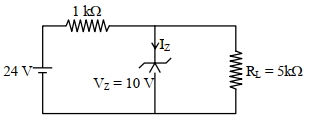
For the given circuit, the power across zener diode is ..... ${mW}.$